Top videos

Metallica doesn't do anything small. Their songs are relentless assaults of sound, sometimes topping the 8 or 9-minute mark. It's not a surprise then that "Metallica: Through the Never," their 3-D IMAX concert film/apocalyptic Mad Max story, directed by Nimród Antal, is a gigantic spectacle, a virtual-reality experience that is both ridiculous and sublime, sometimes in the same moment.
The band members, lead singer/guitarist James Hetfield, lead guitarist Kirk Hammett, drummer Lars Ulrich, and bassist Robert Trujillo, came up with the concept, giving it a personal stamp which longtime Metallica fans will recognize. The Metallica concert in the film features laser beams, a Tesla coil shooting actual lightning bolts through the air, a gigantic statue of Lady Justice which crumbles to bits around the band members, white crosses emerging from beneath the stage floor, dry ice…the only thing missing from that arena stage is an 18-inch tall Stone Henge. Meanwhile, there's a fictional storyline that runs alongside the concert: a young roadie named Trip (Dane DeHaan) is sent on an important mission to retrieve a bag needed by the band. "Metallica: Through the Never" moves back and forth, from concert to Trip and back.
The concert was filmed at Rexall Place, an arena in Edmonton, Alberta. The stage is huge and cross-shaped, with Lars Ulrich's drum set placed in the transept. The three other guys wander around freely, sometimes meeting up, but mostly facing out, communicating with the masses of gyrating fans. Twenty-four cameras were used, and cinematographer Gyula Pados brings us in close enough that we can almost feel the sweat flying off of Trujillo's long hair as he spins his head, and also pulls us back, way back, to give a sense of the sheer scope of the production and the audience. The fans are packed in tight, pushing against the barriers near the stage, pulsing their arms in the air. The effect of all of this is so visceral and immediate that it really is the next best thing to being there.
Cutting away from the concert to follow Trip's attempt to retrieve the missing bag is a risky device and doesn't work initially, because the concert is so engrossing you resent being made to leave it. But it grew on me as the film progressed, and ended up having a startlingly emotional resonance by the closing shots of the film. Here's what happens. Trip takes off in a battered van to go get this missing bag. Civilization appears to have broken down. Cars are on fire. Riot police and mobs face off. People are strung up from lampposts and dangle in the wind. (There's a reason "Metallica: Through the Never" is rated R.) Trip finds himself singled out by the mob. A literal horseman of the Apocalypse, wielding a gigantic mallet and wearing a gas mask, gallops after him. Trip is beaten up, set on fire, dragged behind a horse, chased through dark alleys. What is in the bag that Metallica needs? Well, if you've seen your Hitchcock, then you know that doesn't matter.
All of these scenes are tied thematically to Metallica's concert song list, which span the 30 years of Metallica's career, from early songs like "Creeping Death," to later songs like "Cyanide." All the major hits are covered: "Master of Puppets," "One," "The Memory Remains," "Enter Sandman," "And Justice For All," "Battery," "Nothing Else Matters." Metallica's music is not light. They are not carefree guys. Even their ballads are gloomy. Trip's struggle to survive in a violent dystopian world is reflective not only of Metallica's most common themes, but also echoes what the music actually sounds like. Metallica's music is fast, aggressive, and demanding. As macho as Metallica's collective stage presence is, what they tap into is a very dark place where they are alone, helpless, and isolated. Music critic Steve Huey once observed that "in one way or another, nearly every song on 'Master of Puppets' deals with the fear of powerlessness." That's where the rage comes from.
Trip, as played by Dane DeHaan, is a skinny kid in black jeans and a hoodie. He is overwhelmed by forces larger than him. He is not physically strong. He is an outcast. James Hetfield may be a tattooed rock god, wearing all black and a bullet belt, stalking around on a stage the size of St. John the Divine like he owns the joint, but he still identifies with guys like Trip. He identifies with the outcasts, the scared kids of the world ("Enter Sandman." their most famous song, features a child's voice praying), and Trip is the stand-in for all kids who feel like they don't fit in, who are scared and feel powerless, who find strength in music like Metallica's. That's when the device stopped feeling like a device and felt like an expression of the band's identification with its own fan base, with the guys they used to be.
It was 1983 when Metallica's first album came out, a year where The Police and Michael Jackson dominated the pop charts. Heavy metal fans were part of a vibrant underground scene, where bootleg cassette tapes were passed around. Metallica are Rock and Roll Hall of Famers now. Their actions (and albums) have not always pleased their hard-core fan base. Remember when they sued Napster? Remember "Load," their sixth album, seen by many fans as a betrayal of what the band was all about? Some of the oldest fans think Metallica sold out with what is known as "the black album." These things are still being argued about on heavy metal websites and fan forums. And then of course, they all went into therapy in order to heal the rifts in their relationships, a process documented in the fascinating 2004 documentary "Some Kind of Monster." The album that resulted from that therapy process, "St. Anger," received mixed reviews but still sold millions of copies. You can see that up-and-down journey in the concert itself, as technical snafus threaten to derail the whole thing, forcing the band to go back to basics.
Some of the best moments in the film involve footage of the concert audience. There is one audience member I keep remembering, and he appears for only a second. He was pushed up against the barrier. He had his shirt off, like a lot of the guys did, and his arms were in the air, eyes closed, lost to everything else but that immediate moment. There are millions more of him around the world. And there were thousands more in that arena. The sound of the audience singing along is so powerful it sounds like a political rally about to turn violent. Even James Hetfield at one point seems a bit taken aback at the collective sound of thousands of people singing his lyrics. At the end of the film, during the credits, the words "To the Metallica Family of Fans" scroll by on the screen. "Metallica: Through the Never" is a vehicle that could reach a new generation of fans, who wouldn't even know what the term "bootleg cassette tape" meant, but know great music when they hear it.
With all of the dazzling special effects "Metallica Through the Never" offers, and with all of the violent encounters poor fictional Trip experiences, it's that shirtless fan, arms raised, that encapsulates what the film is all about, encapsulates what Metallica is all about. To paraphrase one of Metallica's most famous lyrics, that's the memory that remains.
REVIEW RESOURCE: https://www.rogerebert.com/rev....iews/metallica-throu

This video was made in collaboration with Academy of Ideas. They create videos explaining the ideas of history's great thinkers in order to help supply the world with more knowledge, to empower the individual, and to promote freedom. Please check out their youtube channel for more brilliant content.
https://www.youtube.com/c/academyofideas or visit their website to learn more https://academyofideas.com/
In this video we are going to explore the most dangerous of all psychic epidemics, the mass psychosis. A mass psychosis is an epidemic of madness and it occurs when a large portion of a society loses touch with reality and descends into delusions. Such a phenomenon is not a thing of fiction. Two examples of mass psychoses are the American and European witch hunts 16th and 17th centuries and the rise of totalitarianism in the 20th century.
This video will aim to answer questions surrounding mass psychosis: What is it? How does is start? Has it happened before? Are we experiencing one right now? And if so, how can the stages of a mass psychosis be reversed?

THE PLAN shows the official agenda of the World Health Organization to have ten years of ongoing pandemics, from 2020 to 2030. This is revealed by a WHO virologist, Marion Koopmans. You will also see shocking evidence that the first pandemic was planned and abundantly announced right before it happened. Make sure to watch, and share this everywhere.
The WHO has planned for 10 years of infetious dieseases, from 2020 to 2030. So be prepared for NEXT PANDEMIC step.
More information, and to see all the documents in THE PLAN, go to: https://www.stopworldcontrol.com/proof

A provocative look at what it takes to hide a multi-trillion dollar Secret Space Program from the public and the implications this has for humanity.
Featuring: David Wilcock, Corey Goode, John Desouza, Niara Isley, Jordan Sather, and more.
On September 10th 2001 Secretary of Defense Donald Rumsfeld announced that $2.3 trillion dollars could not be accounted for within Department of Defense expenditures. The very next day the Pentagon’s budget analyst’s office was destroyed in the 9/11 attack. The mystery remains: Where are the missing trillions Above Majestic is a shocking and provocative look at what it would take to hide a multi-trillion-dollar Secret Space Program (a clandestine group of elite military and corporate figureheads charged with reverse-engineering extraterrestrial technology also known as “Majestic 12”) from the public and the implications this would have for humanity.
Viewers will be guided through a deep dive into the origins, technologies, history, cover ups, conspiracies, testimony and research that goes beyond and Above Majestic. Featuring some the most prominent and prolific authors, researchers, whistle-blowers and disseminators in the movement for Truth and Full Disclosure. This includes David Wilcock, Corey Goode, John Desouza, William Tompkins, David Adair, Laura Eisenhower, Niara Isley, and Jordan Sather.
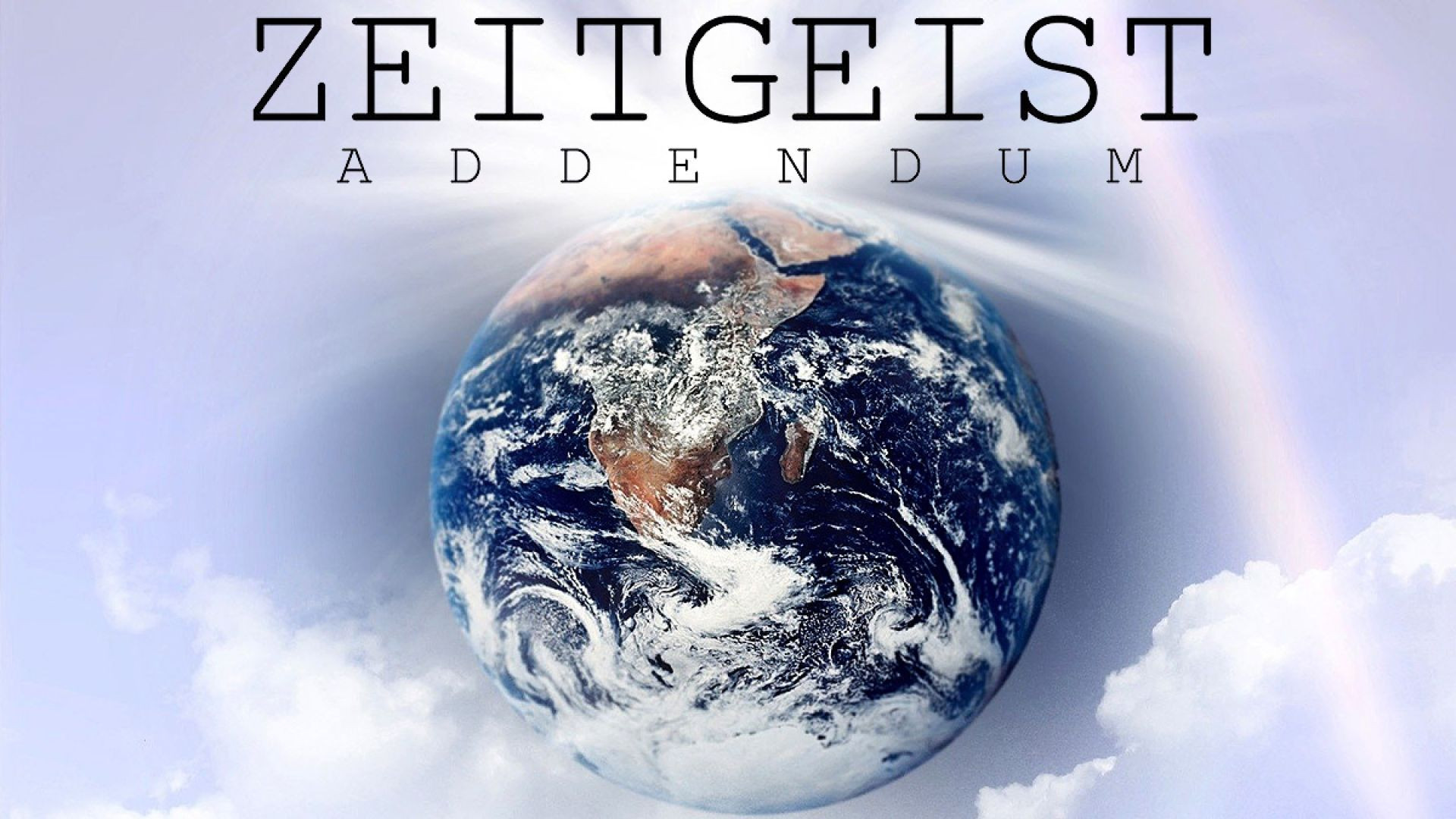
The second documentary film of the series, Zeitgeist: Addendum, attempts to locate the root causes of this pervasive social corruption, while offering a solution.
Building upon the topics of social distortion and corruption, Addendum moves to also present possible solutions. Featured in the work is former “Economic Hit-man” and New York Times bestselling author, John Perkins, along with The Venus Project, an organisation for social redesign created by Social Engineer and Industrial Designer Jacque Fresco.
The original Zeitgeist was actually not a “film”, but a performance piece, which consisted of a vaudevillian style multi-media event using recorded music, live instruments and video. The event was given over a 6-night period in New York City and then, without any interest to professionally release or produce the work, was “tossed” up on the Internet arbitrarily. The work was never designed as a film or even a documentary in a traditional sense - it was designed as a creative, provoking, emotionally driven expression, full of artistic extremity and heavily stylized gestures. However, once online, an unexpected flood of interest began to generate. Within 6 months over 50 Million views were recorded on Google Video counters. Suddenly “Zeitgeist” the event, became “Zeitgeist: The Movie”.
Zeitgeist: The Movie (2007) is a treatment on Mythology and Belief in society today, presenting uncommon perspectives of common cultural issues. Chapter 1, “The Greatest Story Ever Told”, presents historical data relating to the astronomical/astrological origins of the Judeo-Christian theology (which can be extended to Islam as well), along with the understanding that these respective stories, beliefs & traditions are really an adaptation-extension of prior Pagan beliefs.
Chapter 2, “All the World’s a Stage”, presents a controversial view of the events of Sept. 11th 2001. It describes how the event has been transformed into a sacred, near religious act and to challenge the orthodox view, regardless of the quality of the contrary arguments, is considered blasphemy and rejected.
Chapter 3, “Don’t Mind the Men Behind The Curtain “, presents a shotgun tour through the subjects of Central Banking, War Pretexts, Banking Panics, the Military Industrial Complex, Media Culture and ultimately the mental neurosis and deadly addiction known as “Power.” The central theme is how society is often misled when it comes to certain pivotal historical events, what those events serve in function, along with how the overall social conditioning patterns we see today function to create values and perspectives which support and perpetuate the static, established order/power structure, as opposed to fluid social change and productive evolution for the betterment of the society as a whole.
The director, producer, writer, cinematographer, composer, editor and narrator of the work, Peter Joseph, was inadvertently brought into recognition within the documentary film community with his award winning, controversial, 2007 work “Zeitgeist: The Movie” which obtained over 100,000,000 views online during the first year of its publication.
Since that time, he continues to focus on media related expressions, including music composition, performance & film production, each with the focus on affecting society for the better. He has also lectured around the world on the topics of social sustainability and filmmaking and has been featured in the New York Times, Russia Today, TedX, CineFuturo and many other outlets. His film series have earned dozen of awards and have been screened in virtually every country and in over 40 languages. For more about The Zeitgeist Film Series and its history: www.zeitgeistmovie.com

Citizenfour is a 2014 documentary film directed by Laura Poitras, concerning Edward Snowden and the NSA spying scandal. The film had its US premiere on October 10, 2014, at the New York Film Festival and its UK premiere on October 17, 2014, at the BFI London Film Festival.
The film features Snowden and Glenn Greenwald, and was co-produced by Poitras, Mathilde Bonnefoy, and Dirk Wilutzky, with Steven Soderbergh and others serving as executive producers. Citizenfour received critical acclaim upon release, and was the recipient of numerous accolades, including Best Documentary Feature at the 87th Academy Awards. This film is the third part to a 9/11 trilogy following My Country, My Country (2006) and The Oath (2010).
In January 2013, Laura Poitras, an American documentary film director/producer who had been working for several years on a film about monitoring programs in the United States that were the result of the September 11 attacks, receives an encrypted e-mail from a stranger who calls himself "Citizenfour." In it, he offers her inside information about illegal wiretapping practices of the US National Security Agency (NSA) and other intelligence agencies.
In June 2013, accompanied by investigative journalist Glenn Greenwald and The Guardian intelligence reporter Ewen MacAskill,[6] she travels to Hong Kong with her camera for the first meeting with "Citizenfour" in a hotel, who reveals himself as Edward Snowden. Scenes of their meeting take place in Snowden's hotel room, where he maintains his privacy. Shots of Snowden in his bed, in front of his mirror and of the hotel from a distance form the character of Snowden as a trapped political agent.
After four days of interviews, on June 9, Snowden's identity is made public at his request. As media outlets begin to discover his location at the Mira Hotel, Snowden moves into Poitras' room in an attempt to elude phone calls made to his room. Facing potential extradition and prosecution in the United States, Snowden schedules a meeting with the United Nations High Commissioner for Refugees and applies for refugee status. After Poitras believes she is being followed, she leaves Hong Kong for Berlin, Germany.
On June 21, the US government requests the Hong Kong government extradite Snowden. Snowden manages to depart from Hong Kong, but his US passport is cancelled before he can connect to Havana, stranding him in the Sheremetyevo International Airport in Moscow for 40 days. On August 1, 2013, the Russian government grants Snowden temporary asylum for a period of one year.[8] Meanwhile, Greenwald returns to his home in Rio de Janeiro and speaks publicly about United States' utilization of NSA programs for foreign surveillance. Greenwald and Poitras maintain a correspondence wherein they both express reluctance to return to the United States.
Throughout, the film offers smaller vignettes that precede and follow Snowden's Hong Kong interviews, including William Binney speaking about NSA programs, and eventually testifying before the German Parliament regarding NSA spying in Germany.
The film closes with Greenwald, Snowden and Poitras meeting once again, this time in Russia. Greenwald and Snowden discuss new emerging details on US intelligence programs, careful to only write down and not speak critical pieces of information. Greenwald tears these documents creating a pile of scraps, before slowly removing them from the table.

The fact that the footage of 1969’s Harlem Cultural Festival that makes up the bulk of Summer of Soul languished for so long outside of the public eye is an injustice. The fact that first-time filmmaker Ahmir “Questlove” Thompson has now brought it all brilliantly into the light makes him not only a documentarian but a revolutionary. The stunning 1969 performances themselves are worth the price of admission, but they grow even more transcendent when spliced together with delightful talking head interviews and haunting historical context. The result is both archival and activating, showcasing a past cultural moment while pushing audiences to pour new energy into the present and the future.
Dubbed “the Black Woodstock” by Hal Tulchin, the man who rolled cameras as the event unfurled, the moving parts of the Harlem Cultural Festival represent a movement that is far more than what that nickname might suggest. The brainchild of event organizer Tony Lawrence, attended by thousands, and boasting a lineup of essential artists, it was and remains an overwhelming example of co-creative, faith-fueled community organizing. There are abundant shots of the crowd accompanying the footage of the performers, but these attendees never seem as if they are simply onlookers. They instead look like they are simultaneously at church, at a rally, and at a club, showing how intersectional true spiritual experience can be, pulling in elements from all three sacred spaces and crafting something that can’t exist without all of the ingredients.

And, in turn, the performers deliver a combination of a service, a protest, and a show. Though good showings are to be expected from names like Nina Simone, Stevie Wonder, The Fifth Dimension, Sly and the Family Stone, and Gladys Knight and the Pips, the performances in Summer of Soul reach greater heights than could be expected. Whether or not these are the best technical performances that these stars have achieved is hardly the matter; these aren’t just performances, they’re incantactions, invocations, and explosions of unshakeable inspiration.
Though there are countless high points, the centerpiece of the performance footage is an impromptu “Precious Lord, Take My Hand” duet between a weary Mahalia Jackson and a fresh-faced Mavis Staples. This collaboration would have been a wow moment even if just performed well but these two vital voices combine to craft something almost otherworldly, something that truly must be experienced to be understood.

The interviews and accompanying contextual footage add both levity and gravity to the proceedings. Hindsight reflections from performers and audience members show the human hearts and souls at the center of the excitement while accompanying snapshots of what was occurring in the world outside Harlem’s Mount Morris Park keep the happening firmly planted in the bending moral arc of the universe.
Together, these aspects make Summer of Soul a truly prophetic offering, not simply a chronicle, not merely a concert film, but something wholly different and beautifully holy. It’s a passion project that not only unearths and restores a long-hidden piece of history; it might also contain enough restorative breath to unearth a collective liberative spirit that is in need of regular resurrection.
REVIEW RESOURCE: https://www.spiritualityandpra....ctice.com/films/revi

Mary Gray was born in Paris in 1886.
She knew many of the outstanding leaders of thought in Europe and America. She was a member of the Theosophical Society.
What the book is about?
This book was written in 1925 and shows why spiritual growth is sometimes gained through the darkest times in our lives.
Sometimes we must just accept the pain of living along with the joys in our lives and know they both come from God and make us stronger.
Life is a journey, a struggle at times but worth every minute and I am thankful for the people that help us through it.

Is this how it all started? The mystery of human origins. Where did we come from? With many leading explanations being highly improbable.. Could this be the missing piece to the puzzle?
The 5th Kind Presents: Improbable Cause - A Film & Animation by Giovanni Lodigiani. Music Credits: https://www.trax4pro.com/ - Pro Tracks Available for Licence and use your own Projects. Visit the website for more information.
RESOURCE: https://www.5thkind.tv/

A documentary film about the origins, development and expansion of one of the most elitist and secret organizations in today's world. Once a year, the most powerful people allegedly meet behind closed doors to discuss their secret agenda.
The Bilderberg Group is believed to be made up of European prime ministers, North American presidents, and the most affluent CEOs on the planet. Together they come together and discuss the economic interests and political future of humanity. Journalists have never been allowed to attend, nor have statements ever been released on the meetings, which have incredible implications on the citizens of the world.
Featuring: Daniel Estulin, Pilar Urbano, Nigel Farage, Mario Borghezio, Jeffrey Steinberg, Lyndon Larouche, Dennis Small, Helga Zepp-Larouche, Michael Billington, Gerard Aalders, Denis Healey
Director’s Note
How and when was it created? Who are they? What do they do, how they do it, and why do they do what they do? Is there anything we can do about it? These were some of the basic questions that came to mind when I accepted Daniel Estulin’s offer to make this documentary film. My greatest fear: that the density of the subject itself would end up distracting the viewer’s attention. My only goal: simplify; make it straightforward; present facts, evidence, cross-checked information. And the big challenge: the film had to maintain a pace, be visually entertaining, beautiful and dynamic, on the one hand; and deeply informative, on the other.
To explain through visual images the existence of an almost ethereal entity, its headquarters – a 20m2, second floor walk up on a quiet street in Leiden, the Netherlands manned only by an answering machine; its members – faceless and nameless to the rest of the world refuse to grant public interviews, was not an easy task. The same organization, its outward secrecy and the shadow of accusations of conspiracy leveled against those who have dared to broach the subject, are also circumstances that made this process much more complex for me, as a filmmaker.
How do you explain to someone who demands freedom, that all he has to do is walk through the open door in front of him? How can I show through images, that the truth that almost everyone considers as such, is a lie? How do I show that this truth, which is not reality, is based on lies which, after repeating them and believing them, end up becoming real? What is the truth? What is reality?
Reality is just that — the truth. A lie, on the other hand, has to have a meaning to be first promulgated and then accepted by the masses. The hardest thing for us, based on how we have been taught to think, is to learn how to detect a lie. The objective of this film is to find the cause whose effect is the lies that are continuously sold to us, as well as to deeply and precisely understand the magnitude of this reality, and its palpable consequences in our lives.
Joan Cutrina

It was among the fastest, most efficient production cars ever built. It ran on electricity, produced no emissions and catapulted American technology to the forefront of the automotive industry. The lucky few who drove it never wanted to give it up. So why did General Motors crush its fleet of EV1 electric vehicles in the Arizona desert?
WHO KILLED THE ELECTRIC CAR? chronicles the life and mysterious death of the GM EV1, examining its cultural and economic ripple effects and how they reverberated through the halls of government and big business.
The year is 1990. California is in a pollution crisis. Smog threatens public health. Desperate for a solution, the California Air Resources Board (CARB) targets the source of its problem: auto exhaust. Inspired by a recent announcement from General Motors about an electric vehicle prototype, the Zero Emissions Mandate (ZEV) is born. It required 2% of new vehicles sold in California to be emission-free by 1998, 10% by 2003. It is the most radical smog-fighting mandate since the catalytic converter.
With a jump on the competition thanks to its speed-record-breaking electric concept car, GM launches its EV1 electric vehicle in 1996. It was a revolutionary modern car, requiring no gas, no oil changes, no mufflers, and rare brake maintenance (a billion-dollar industry unto itself). A typical maintenance checkup for the EV1 consisted of replenishing the windshield washer fluid and a tire rotation.
But the fanfare surrounding the EV1’s launch disappeared and the cars followed. Was it lack of consumer demand as carmakers claimed, or were other persuasive forces at work?
Fast forward to 6 years later... The fleet is gone. EV charging stations dot the California landscape like tombstones, collecting dust and spider webs. How could this happen? Did anyone bother to examine the evidence? Yes, in fact, someone did. And it was murder.
The electric car threatened the status quo. The truth behind its demise resembles the climactic outcome of Agatha Christie’s Murder on the Orient Express: multiple suspects, each taking their turn with the knife.
WHO KILLED THE ELECTRIC CAR? interviews and investigates automakers, legislators, engineers, consumers and car enthusiasts 4 from Los Angeles to Detroit, to work through motives and alibis, and to piece the complex puzzle together. WHO KILLED THE ELECTRIC CAR? is not just about the EV1. It’s about how this allegory for failure—reflected in today’s oil prices and air quality—can also be a shining symbol of society’s potential to better itself and the world around it. While there’s plenty of outrage for lost time, there’s also time for renewal as technology is reborn in WHO KILLED THE ELECTRIC CAR?
Director: Chris Paine
Writer: Chris Paine
Cast: Martin Sheen(voice), Tom Hanks (archive footage), Mel Gibson

This is a short story about the early life stage of Ram Bahadur Bomjon - called Incarnation of Lord Buddha.
In Nepal, five hours from Katmandou, thousands of people, irrespective of wich caste they belong to goes each day on a pilgrimage, on foot or on cart. There, in the middle of the forest, they come to meditate and pray in front of a 16 year old boy. 24 hours a day, this young man sits in the hollow of a tree, in full meditation.
He does not move, he does not eat, he does not drink. He remains sitted quiet, breathes very little, very gently and does not need anything. For the believers, he is the reincarnation of Buddha! Miracle or not? We followed the traces of this man that all Nepali already call Little Bouddha.
WIKI Note
Ram Bahadur Bomjon (Sanskrit: राम बहादुर बम्जन) born c. 1990, sometimes spelled Bomjan, Banjan, or Bamjan), previously known as Palden Dorje (his monastic name) is a controversial ascetic from Ratanapuri, Bara district, Nepal who gained widespread attention and media popularity because of perceived semblances to Gautama Buddha, leading to claims that he is a reincarnation of Gautama Buddha.
In May, 2005, the 15 year old Bomjon left his home near the Indian border after a dream in which a god appeared to him and told him to do so, and sat amongst the roots of a pipal tree to meditate. Claims suggest that for 10 months he rarely spoke, drank, ate, or even moved. Thousands, if not hundreds of thousands of people visited the site to see the boy motionless for hours, days or as rumoured even months, or came in devotion to the possibility of an important spiritual event occurring. As a result of some of these claims, Bomjon's followers believe he is an incarnation of the historical Buddha, Gautama. Bomjon has rejected any such comparisons, saying "Tell the people not to call me a Buddha. I don't have the Buddha's energy currently. I am at the level of a rinpoche." Mahiswor Raj Bajracharya, the president of the Nepal Buddhist Council, has stated likewise: "We do not believe he is Buddha. He does not have Buddha's qualities".
Then, on 11 March 2006 he went missing. On 19 March 2006 Bed Bahadur Lama of the Om Namo Buddha Tapaswi Sewa Samiti (ONBTSS) told reporters that they had seen him in Bara District and that they had spoken to him for half-an-hour, during which Bomjon reportedly assured that he would return in six years.
He was again seen in August 2007, preaching to crowds in Nepal’s Hallori jungle, around 100 miles south of Kathmandu.
Controversies
Bomjon's followers have claimed that Bomjon meditates for months without eating or sleeping.
In 2010, Bomjon was investigated for attacking a group of 17 villagers. Bomjon claimed that they were intentionally disturbing his meditation. However, the villagers said they were just looking for vegetables. Bomjon claimed to have taken "minor action" against them with just his hands after they had "tried to manhandle" him, and stopped as soon as they apologized. However, the victims claim that for three hours he struck them on their head and back with an axe handle, resulting in serious injury of one of the victims. Bomjon refused to attend any potential trial, stating, "Do you think a meditating sage will go to the court to hear a case? I took action against them as per the divine law".
In 2012 Nepal Police announced that they had rescued a Slovak woman from Bomjon's followers, but other reports claimed that she had been voluntarily released after media coverage of the kidnapping. Newsweek reported she had been taken from a hotel by two of Bomjon's men riding on a motorcycle and kept tied to a tree for three months and accused of practicing witchcraft in order to disturb the Boy’s meditation. However another report claimed she had been kidnapped from a monastery. When she was released she had a broken arm. A week after her release, Bomjon's siblings accused him of holding his brothers captive overnight, and beating his brothers and his sister. Followers of Bomjon also assaulted five journalists and destroyed their cameras after they had recorded one of Bomjon's sermons.
In September 2018, Bomjon was accused of raping an 18 year old nun repeatedly for nearly 2 years. During a press conference organized by women's rights groups, the nun also accused his wife of trying to keep the abuse hidden so as not to "attract attacks" on their religion. Supporters of Bomjon claim that the nun was in fact involved in theft, and had been ejected from the monastery.
An investigation was opened in January of 2019 after complaints from family members that four devotees had gone missing from several of Bomjon's ashrams. In the same month, police raided one of Bomjon's ashrams in Nepal, but he was not found. On February 6th, 2020, the Sarlahi District Court issued an arrest warrant against Bomjon. The following day, police raided another one of his ashrams, but Bomjon again was not found. However, police did arrest one of his disciples, Gyan Bahadur Bomjan.
More info on official website: https://rambahadurbomjon.wordpress.com

Covered the big topics very, well. Amazing how much you covered in such a short time. Great collaboration. It is definitely a unique film/documentary that covers issues rarely covered. Compared to a national geographic film on the same topic, this one is a much better piece. Great cinematics, use of drone footage, excellent camera work and great sound too.

HAARP, in full High-frequency Active Auroral Research Program, scientific facility for studying the ionosphere, located near Gakona, Alaska. The main instrument is the Ionospheric Research Instrument (IRI), an array of 180 radio antennas spread over an area of 0.13 square kilometer (33 acres).
The ionosphere is the outermost layer of Earth’s atmosphere. It begins at about 50 kilometers (30 miles) above Earth’s surface and contains atoms and molecules that are ionized (that is, they lose an electron and become positively charged) by the Sun’s ultraviolet light. The ionosphere is of particular importance for radio because low radio frequencies are reflected off the ionosphere, allowing for long-distance communications. At higher frequencies, radio communications with satellites pass through the ionosphere. The ionosphere is also where the auroras occur when solar wind particles collide with oxygen and nitrogen atoms.
The IRI transmits at frequencies between 2.7 and 10 MHz with a power of 3.6 megawatts. It transmits radio waves upward into the ionosphere, where they cause electrons to move in waves. HAARP is an ionospheric heater, so called because the excitation of electrons increases their temperature, and it is the most powerful ionospheric heater in the world. By altering the density of electrons in a specific region, scientists using HAARP can study how the ionosphere reacts to changing conditions.
Because of the ionosphere’s significance for radio communications, in the early 1990s the U.S. Air Force and U.S. Navy proposed the HAARP project, and the Air Force began construction in 1993. The site near Gakona was chosen because it was an area of flat ground that was in the North Polar region where auroras occur. The HAARP site was near a major highway but isolated enough that there were no nearby sources of electrical or radio interference. Responsibility for HAARP was transferred to the University of Alaska Fairbanks in 2015.
HAARP became a popular subject of conspiracy theories. Venezuelan Pres. Hugo Chávez blamed it for the 2010 Haiti earthquake, but most such theories about HAARP concern its use for weather modification or mind control. In response, HAARP scientists noted that the ionosphere is far above the troposphere and stratosphere where Earth’s weather actually happens, and, as for any other effects, HAARP scientists stated that the amount of energy the IRI deposits in the ionosphere is far below that supplied naturally by the Sun and that any effects from the IRI quickly dissipate.
(https://www.britannica.com/topic/HAARP)

The G7 central bankers met on August 22nd 2019 at the Jackson Hole, Wyoming meeting, where they gather once a year, and they voted on a plan called the Going Direct reset. I would describe it as the ‘real reset’ behind what the World Economic Forum describes as the Great Reset. I think of the Great Reset of the World Economic Forum as sort of a marketing plan for the Going Direct reset.
What is the financial coup d’etat? – between fiscal 1998 and 2015, 21 trillion dollars that we know of went missing from the US government. The beginning of this was described to me by the president of the largest pension fund in the United States. In 1997 he said “they’ve given up on the country – they’re moving all the money out, starting in the fall”. This is privatization on the just do it method, where you pull the assets out, you lever up the governments with debt and bankrupt them, which gives you the ability essentially to take control and end sovereignty. For the last hundred years or so, in the G7 countries, we’ve had a balance of power between the bankers who control monetary policy and then the electorate votes for a parliament or a congress and they oversee the fiscal policy.
What Going Direct is doing, among other things, is basically the central bankers are moving in and taking control of the what the electorate used to run, which is the the fiscal policy and the tax money. The rubber is going to meet the road when it comes down to the taxation system, because if we continue to pay taxes to finance a criminal enterprise that can’t have a good result.
Around the world you start to see more and more people taking over the governments who have a central banking background. This is essentially the consolidation of the coup. Now where is this going?… it’s going to complete central control with the vaccine ID passports, Central Bank Digital Currencies, which is a control system and Universal Basic Income, which destroys people’s ability to produce their own income. To do all of this you need a smart grid.
The general manager of the Bank of International Settlements in Basel, Switzerland, speaking at a conference on cross-border payments in October 2020, described the beauty of the Central Bank Digital Currency system as follows:
“we don’t know, for example, who is using a 100 dollar bill today, we don’t know who is using a 1000 peso bill today. A key difference with the CBDC is that central banks will have absolute control on the rules and regulations that will determine the use of that expression of central bank liability and also we will have the technology to enforce that. Those two issues are extremely important and that makes a huge difference with respect to what cash is.”
So what that means is if you have money in your bank account and the new rule is you’re not allowed to transact further than five kilometers from your home, your card won’t work more than five kilometers from your home. If they don’t want you buying pizza, you can’t buy pizza with money in your in your bank account or with your card. It is complete control. It solves the taxation without representation problem, because if they want more taxes they just come take it out of your account. So when the World Economic Forum said “it’s 2030 you have no assets and you’re happy” what i hear is it’s 2030, we took all of your assets and you’re mind controlled.
Five steps that I want you to consider are:
– Pick a side
We are at a fork in the road. One road leads to slavery the other road leads to freedom. You have to decide which which side you’re on.
– Ask unanswered questions to build a good map of the official simulated reality being presented in the ‘old media’ and actual reality.
We live in a world where there’s an official reality or a simulated reality and it’s very much created by what we’re now calling, thanks to Brian Gerrish of the UK Column news, the old media. The new media is doing a great job of trying to help people navigate between the two. We all are dealing with family and friends who want to stay in the official reality and we need to know what it is and how it works so we can meet them.
You don’t want to use the official reality for risk management because that’s how people lose money to financial fraud and health fraud. If you use your reality map to have a dinner party with friends who don’t want to know about reality, you’re going to lose a lot of friends. We live in a multiple personality disorder world, so you need these two maps to navigate successfully and be effective. You don’t need to drop truth bombs on people in the middle of dinner parties. When there’s a great deal of uncertainty and we don’t have good intelligence, we can ask questions and and the richness of that process of asking questions helps us fill in a map like making a jigsaw puzzle....
RESOURCE: https://www.ukcolumn.org/commu....nity/forums/topic/ca

n the tradition of his first Internet blockbuster, Loose Change, which has had over 100 million visits, Jason Bermas has created yet another outstanding documentary film, Invisible Empire: A New World Order Defined.
This film documents very clearly that some of America's most powerful elected officials, including all recent presidents, have been part of an international cabal to establish a socialist New World Order that would eradicate national sovereignty and many of the God-given freedoms vouchsafed in the Constitution of the United States, making all citizens mere slaves of the state.
It has an amazing collection of video footage of these leaders stating their unabashed ambitions to establishing this New World Order. It also shows just who is behind this international cabal and their nefarious intentions and true sinister nature. It is deeply troubling and very important.
Again, its relevance to Free Energy technology is two-fold. First, these same forces are behind many of the instances of suppression of breakthrough free energy, which would empower the individual, contrary to the NWO agenda to enslave. Second, the emergence of breakthrough free energy technologies will help unseat these criminals. It is a powerful antidote to the poison being administered.
Another point of relevance is that the film touches on the fact that Al Gore is one of the New World Order insiders helping to accomplish their objectives by politicizing climate change and using it as a reason to impose global carbon taxes; all while personally becoming super wealthy from his various involvements that include serious conflicts of interest. He should not be seen as a hero figure in the free energy movement.

Resonance: Beings of Frequency is the first full documentary to investigate the actual mechanisms by which mobile phone technology can cause harm to someone’s well-being.cancer. Filmmakers take a deep dive into how humanity is coping with the emergence of mobile devices.
Billions of years ago, life first appeared on planet earth and bathed in a natural electromagnetic frequency. As life slowly evolved from simple to complex organisms, it was surrounded by this natural frequency, forming a harmonic relationship. This harmony is something science is beginning to understand, and special interest groups are trying to hide.
The balance built over time could be in jeopardy. Over the last two or three decades, this harmony has been disturbed, and dramatically so by technology. Mankind has saturated itself in an ocean of artificial frequencies, overwhelming the earth’s natural resonance. To the naked eye, our world appears the same. But at the cellular level, the health of living organisms is being affected. Yet, we are only starting to scratch the surface.
REVIEW RESOURCE: https://www.gaia.com/video/res....onance-beings-freque

Watch Part TWO (2) here => https://vajratube.com/watch/ge....orge-harrison-living
George Harrison first became known to the world as 'The Quiet Beatle', but there was far more to his life than simply being a part of The Beatles. This film explores the life and career of this seminal musician, philanthropist, film producer and amateur race car driver who grew to make his own mark on the world.
Through his music, archival footage and the memories of friends and family, Harrison's deep spirituality and humanity are explored in his singular life as he took on artistic challenges and important causes as only he could.
Using unseen photos and footage, Academy Award®-winning director Martin Scorsese traces the life of George Harrison in a personal film, weaving together performance footage, home movies, rare archival materials and interviews with his family and friends including Eric Clapton, Terry Gilliam, Eric Idle, George Martin, Paul McCartney, Yoko Ono, Tom Petty, Phil Spector, Ringo Starr and Jackie Stewart.
Watch Part Two( 2) here => https://vajratube.com/v/zHSaEe

Director Mark Levinson's documentary focuses on the most elaborate and costly science experiment ever conducted.
A particularly timely work given the Nobel Prizes for Physics just announced for two of its central figures, Particle Fever succeeds on every level, but none more important than in making the normally intimidating and arcane world of genius-level physics at least conceptually comprehensible and even friendly to the lay viewer. This unexpected look at the long run-up to and successful completion of the most elaborate and costly science experiment ever conducted — the use of the Large Hadron Collider to attempt to find the Higgs boson — is not only fascinating, but also humanizes the field in a way that will inspire practitioners and provoke the curiosity of non-specialists. Set for theatrical release next March, this top-notch account of a major moment in the advance of human knowledge will have a long, full life in all documentary-friendly arenas worldwide.
It’s crucial for starters that the subject is second nature to the filmmakers: director Mark Levinson earned a doctoral degree in particle physics from Berkeley before veering into film, and producer David Kaplan, a professor of theoretical particle physics at Johns Hopkins, has also been active on History Channel and National Geographic science programs. They’re able to simplify and synthesize without dumbing down the material and put non-science-oriented viewers at ease by drawing a smart parallel between science and art: Both endeavors ultimately represent attempts to explain our existence and our place in the universe.
It also doesn’t hurt that both the metaphysical and the (literally) physical backdrop for the film is enormous. The Large Hadron Collider (LHC) is the biggest machine ever built. Buried underground in Switzerland, it resembles but dwarfs any set ever built for a James Bond film, measuring seven stories tall and consisting of a 17-mile ring through which protons, powered by seven-ton super-conducting magnetos, will be sent to collide with each other at a speed aimed to reproduce conditions such as those just after the Big Bang.
The Atlas Experiment, which was initiated in the 1980s, involves 10,000 people from 100 countries and the use of 100,000 computers to deal with all the data. An even bigger such machine was started in the United States but was canceled by Congress after a few years because there were no specific military or commercial applications for the experiment. Trying to convey the magnitude of the project, participants compare it to the building of the pyramids or the moon landings, only bigger.
And what is its raison d’être? This is described in many ways: To try to understand the basic laws of nature, to discover the key particle that holds everything together (which is what the Higgs boson describes), to identify particles scientists know are out there but haven’t been seen and, in the simplest terms, to learn which group of theorists is correct — those who believe in the “super-symmetry” of one universe or the adherents of an ever-expanding “multi-verse” based on randomness and chaos.
The LHC will be the vehicle to take physicists to and, they hope, beyond the outer edge of the scientific frontier as currently acknowledged; everyone in the field is keyed up by the certainty that a new threshold is about to be breached. “It’s going to change everything,” Kaplan predicts.
With foresight, Kaplan and Levinson began production in 2008 and, while the center of action remains the European Center for Nuclear Research (CERN) in Switzerland, the net is cast wide to encompass the perspectives of scientists as they gather there, as well as those following events with computer links elsewhere. The project leader is an Italian woman, Fabiola Gianotti; an American woman, Monica Dunford, provides an emotionally excitable take; a veteran Greek physicist, Savas Dimopoulos, is concerned that he’s too old to be able to take part in what he’s sure will be the exciting next phase of research; while Nima Arkani-Hamed, whose family escaped from revolutionary Iran after 1979, has a great deal riding on the experiment, about which he says, “The hype is approximately accurate.”
Official Website: http://particlefever.com
REVIEW RESOURCE: https://www.hollywoodreporter.....com/movies/movie-rev

David Icke, is an English writer and public speaker, known since the 1990s as a professional conspiracy theorist, calling himself a “full-time investigator into WHO and WHAT is really controlling the world.”
David is the author of over 21 books and 10 DVDs and has lectured in over 25 countries, speaking live for up to 10 HOURS to huge audiences, filling stadiums like Wembley Arena.
In April 2020, Icke gave a two-and-a-half-hour interview to the British online channel London Real. The video is dubbed in English, Spanish and French, and subtitled in multiple other languages.
At the time, it was shared by several million internet users but for some reason the organisations controlling the mass media and all social media blocked this interview completely, and by all possible means, disinformation campaigns were launched to ridicule Icke's theories.
