Top videos

For more than 20 years the CIA studied psychic abilities for use in their top-secret spy program. With previously classified details about ESP now finally coming to light, there can be no more secrets.
Two physicists discover psychic abilities are real only to have their experiments at Stanford co-opted by the CIA and their research silenced by the demands of secrecy. Yet, as both these 'remote viewers' and our audience learn, the 'more you hide something, the more it shines like a beacon in psychic space and this ancient truth can no longer be suppressed.'
The true story of Russell Targ and America's cold war psychic spies, disclosed and declassified for the first time, with evidence presented by a Nobel Laureate, an Apollo Astronaut, and the military and scientific community that has been suppressed for nearly 30 years, now able to speak for the first time.
Targ's understated mantra that "the evidence for extra sensory perception is overwhelming and shows a talent we all share and deserve to know about, leaves us not just with a greater understanding of this unique chapter in U.S. history, but perhaps most importantly a greater understanding of who we are and our larger connection to the world. The CIA, NSA and DIA used it, your tax dollars paid for it, and now you deserve to know about it.

Based upon Theosophy (the Secret Doctrine) this documentary focuses on the evolution of consciousness over millions of years while revealing the secret chronology of human history from ancient Lemuria and Atlantis to our current root race, while following the natural cyclic deluges between races.

The people interviewed for "Kedi," Ceyda Torun's documentary about the teeming street cat population in Istanbul, are not experts, or talking heads, or academics. They are citizens, moving through their lives, interacting with the cats in their neighborhoods, and their comments are casually contemplative, off-the-cuff and profound. The human beings take it upon themselves to care for the cats, feed them, and—even more tellingly—just enjoy observing them. They note each cat's personality quirks, likes and dislikes. They freely admit what these cats bring to their own lives. I am a cat owner, I admit, but even I was surprised at the power of "Kedi." Where did all that emotion come from? It's because what Torun really captures in her unexpectedly powerful film is kindness in its purest form.
The cats of Istanbul are everywhere. They curl up on stoops, car hoods, and cafe benches, they sit on piers and in doorways. They sneak beneath tables at flea markets and leap on scraps outside the fish markets. Torun's film profiles seven individual cats, each with its own distinct life, routine and personality. Considering the sneaky crepuscular habits of cats, following these beasts must have been quite a feat. The footage is astonishing. The film opens with a tabby cat stalking with purpose down a crowded city street, looking for food to bring back to her litter of kittens (stashed in a stairwell). Torun's camera is low to the ground, on the cat's level, following the tabby's determined progress. Watching "Kedi" is like lying down on a quickly-moving skateboard. Cats are wily creatures, and when they don't want to be found, they are not found. But Torun finds them!
There's one cat who hangs out at a restaurant by the water, taking care of the mice. (There's a hilarious night-vision section showing the cat creeping through a drain pipe, eyes ablaze.) There's a cat who dominates the area in front of a busy cafe, fighting off interlopers, harassing her "husband" (pushing him out of the way so she can eat first), and chasing off the floozy cats vying for her man's attention. ("She's the neighborhood psychopath," says a neighborhood resident.) One woman spends a day cooking fresh chicken and then wanders her neighborhood, leaving food for the cats, who swarm around her. She says that she has a lot of pain and the cats are helping her heal. There's one cat who sits outside a bakery, and bats on the windows frantically when it gets hungry. There's a freeform style of communication between cats and humans. They share space. Some cats adore being petted. Others can't abide it. A man who owns a textile store demonstrates that the cat who hangs out in his shop likes pats only when they're rough. Gentle pats drive her crazy. "She gets so much pleasure she almost passes out," he says, and then there's footage of her sprawled on the floor, lost in the sensations. One cat shows up at a woman's window every day for a visit. She lets him in, he strolls around, he eats, and then he clambers back down the tree.
The focus is on the cats, but "Kedi" is really a portrait of community. Torun gives a sense of life in Istanbul, its diversity and beauty, its storefronts and waterfronts, its people. Why there are so many cats in Istanbul, and how they all came to be there, is not explained (except for a casual comment from an interview subject). Political upheaval and turmoil is not addressed at all, although there are disturbing signs everywhere, thrumming underneath the everyday routines. One woman says that it is very difficult to be a woman in Turkey, and that the cats in her neighborhood remind her of what is good in being feminine. There is a lot of concern expressed about the brutal knocking down of old neighborhoods to make way for high-rises. Gentrification disrupts entire ways of life, and the residents worry about that but they also worry about the cats. Where will they go? What will become of them? It can be a heartless world. Caring for one another and caring for animals may seem like a small thing, but Torun's affectionate portrait of these cats—and the people who love them—makes it seem like the most important thing in the world. A restaurant owner keeps a tip jar on the counter, and the money goes into a fund for vet visits for the cats who hang around outside. Imagine that. Torun combines her up-close-and-personal footage of the cats with transcendent drone shots of Istanbul in all its moods and weather.
Watch PART 2 (TWO) here => https://vajratube.com/v/B4mRnJ
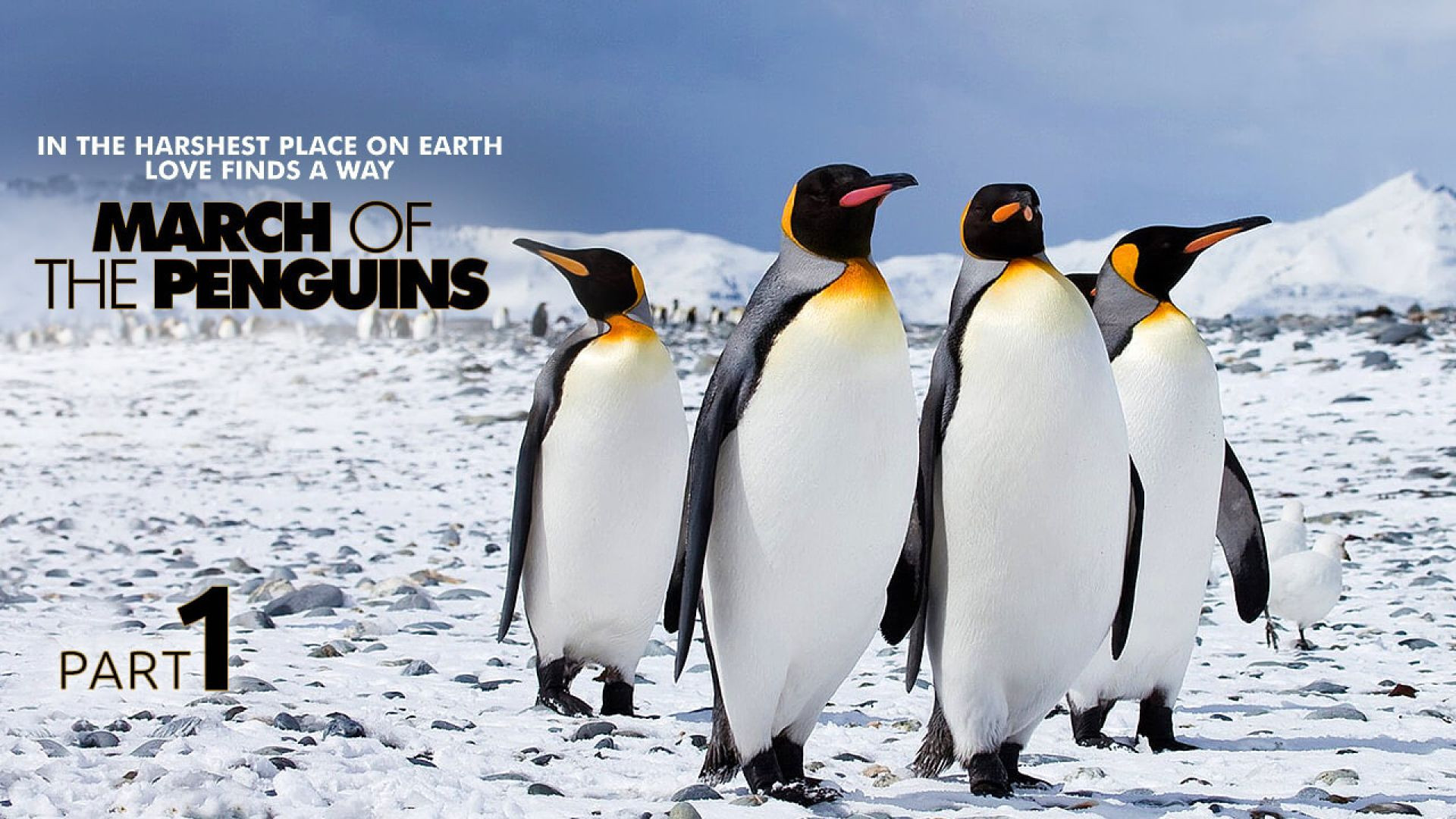
After a long summer of feasting, their bodies stately and plump, the emperor penguins of Antarctica begin to feel, toward autumn, a need to march inland to the breeding grounds "where each and every one of them was born." They are all of a mind about this, and walk in single file, thousands of them, in a column miles long. They all know where they are going, even those making the march for the first time, and when they get there, these countless creatures, who all look more or less the same to us, begin to look more or less desirable to one another. Carefully, they choose their mates.
This is not a casual commitment. After the female delivers one large egg, the male gathers it into a fold of his abdomen, plants his feet to protect the egg from the ice below, and then stands there for two months with no food or water, in howling gales, at temperatures far below zero, in total darkness, huddled together with the other fathers for warmth. The females meanwhile, march all the way back to the sea, now even more distant, to forage for food, which they will bring when the spring comes, if they know it must. When the females return to the mass of countless males, they find their mate without error and recognize the cries of chicks they have never seen.
"March of the Penguins" is simply, and astonishingly, the story of this annual cycle. It was filmed under unimaginable conditions by the French director Luc Jacquet and his team, including the cinematographers Laurent Chalet and Jerome Maison. There is not much to choose from in setting up their shots: On the coldest, driest and (in winter) darkest continent on Earth, there is snow, and there is ice, and there are penguins. There is also an ethereal beauty.
Although the compulsion to reproduce is central to all forms of life, the penguins could be forgiven if they'd said the hell with it and evolved in the direction of being able to swim to Patagonia. The film's narrator, Morgan Freeman, tells us that Antarctica was once a warm land with rich forests that teemed with creatures. But as the climate grew colder over long centuries, one lifeform after another bailed out, until the penguins were left in a land that, as far as they can see, is inhabited pretty much by other penguins, and edged by seas filled with delicious fish. Even their predators, such as the leopard seal, give them a pass during the dark, long, cold winter.
"This is a love story," Freeman's narration assures us, reminding me for some reason of Tina Turner singing "What's Love Got to Do With It?" I think it is more accurately described as the story of an evolutionary success. The penguins instinctively know, because they have been hard-wired by evolutionary trial and error, that it is necessary to march so far inland because in spring, the ice shelf will start to melt toward them, and they need to stand where the ice will remain thick enough to support them.
As a species, they learned this because the penguins who paused too soon on their treks had eggs that fell into the sea. Those who walked farther produced another generation, and eventually every penguin was descended from a long line of ancestors who were willing to walk the extra mile.
Why do penguins behave in this manner? Because it works for them, and their environment gives them little alternative. They are Darwinism embodied. But their life history is so strange that until the last century, it was not even guessed at. The first Antarctic explorers found penguins aplenty, but had little idea where they came from, where they went to, and indeed whether they were birds or mammals.
The answers to those questions were discovered by a man named Apsley Cherry-Garrard, in one of the most remarkable books ever written, The Worst Journey in the World (1922). He was not writing about the journey of the penguins, but about his own trek with two others through the bitter night to their mating grounds. Members of Scott's 1910-1912 expedition to the South Pole, they set out in the autumn to follow the march of the penguins, and walked through hell until he found them, watched them, returned with one of their eggs. Cherry-Garrard retired to England, where he lived until 1959; his friends felt the dreadful march, and the later experience of finding the frozen bodies of Scott and two others, contributed to his depression for the rest of his life.
For Jacquet and his crew, the experience was more bearable. They had transport, warmth, food and communication with the greater world. Still, it could not have been pleasant, sticking it out and making this documentary, when others were filming a month spent eating at McDonald's. The narration is a little fanciful for my taste, and some of the shots seem funny to us but not to the penguins. When they fall over, they do it with a remarkable lack of style. And for all the walking they do, they're ungainly waddlers. Yet they are perfect in their way, with sleek coats, grace in the water and heroic determination. It's poignant to watch the chicks in their youth, fed by their parents, playing with their chums, the sun climbing higher every day, little suspecting what they're in for.
REVIEW RESOURCE: https://www.rogerebert.com/rev....iews/march-of-the-pe

This speech does not require a single word of comment. Only one thing I would suggest is please take a comfortable seated position because standing up you may not be able to bear the weight of exposed facts.
Peter Daszak's quote:
“We need to increase public understanding of the need for medical countermeasures such as a pan-coronavirus vaccine. A key driver is the media, and the economics will follow the hype. We need to use that hype to our advantage, to get to the real issues. Investors will respond if they see profit at the end of the process.”
Source: National Academy of the Press Feb 12, 2016
I hope that the contemporary dr. Josef Mengele known as dr. Fauci - will never get out of the prison.

An exposé on how Hollywood and the mainstream media manipulate the multitudes by spreading propaganda throughout their content.
The movie is banned most of the media.
The Out Of Shadows documentary lifts the mask on how the mainstream media & Hollywood manipulate & control the masses by spreading propaganda throughout their content. Our goal is to wake up the general public by shedding light on how we all have been lied to & brainwashed by a hidden enemy with a sinister agenda.
This project is the result of two years of blood, sweat and tears by a team of woke professionals. It’s been independently produced and funded and is available on many different platforms for FREE for anyone to watch. Patriots made this documentary with the sole purpose of getting the truth out there. If you like the documentary, please share this video.
Official website: www.outofshadows.org

The Hollywood Vampires take their name from an all-star social club that drank itself to oblivion during the mid 1970s at the Rainbow Bar and Grill on The Sunset Strip. The 2019 documentary The Rainbow chronicles the restaurant’s place in the Los Angeles music scene and is an engaging profile of the family that’s run it for three generations (that is, when it’s not indulging in lazy nostalgia). Directed by Zak Knutson, it is currently streaming on Amazon Prime.
Since opening in 1972, the Rainbow has offered food and drinks to successive generations of rockers. Located in West Hollywood, betwixt a cluster of music venues, it was popular with bands visiting Los Angeles as well as those living and trying to make it in the City of Angels. Besides the Hollywood Vampires – which included Alice Cooper, a couple Beatles and riotous Who drummer Keith Moon, Led Zeppelin picked up groupies there, The Runaways ate there and a teenage Slash snuck in dressed as a woman. Motörhead’s Lemmy loved the place so much he bought an apartment within walking distance and was often found drinking Jack Daniel’s and playing video poker at the bar for hours on end.
Behind it all was the Maglieri family, led by tough talking patriarch Mario, who came to Los Angeles from Chicago in the early 1960s to help run another storied local institution, the Whisky A Go Go. Mario is hard not to like, dropping one-liners like “I had rock n’ roll in my bar in Chicago before you ever heard of rock n’ roll,” calling Jim Morrison “a good kid,” and telling stories about throwing Charles Manson out on his ass, like a real life Cliff Booth. “He says, ‘I’m Jesus.’ I tell him, ‘I’m God motherfucker. Now get up from that chair.’ He got up or I’d have had to beat the shit out of him. Either one.”
Though its capacity was in the hundreds, the Whisky became one of the most important L.A. music clubs of the ‘60s and ‘70s. The Doors and Chicago were the house bands at various times, Van Halen used it to built their audience and scores of trailblazing acts made their area on its stage. As Kiss’ Gene Simmons says, “When you first start out and before you figure out your game, the Whisky’s the place to do it.” In fact, the Maglieri have an interest in both the Whisky and the Rainbow, and the film is as much about the venue as the bar up the street.
As the ’70s turned to the ’80s, hard rock turned to metal, from glam to thrash, and again found a home on the Sunset Strip. W.A.S.P. and L.A. Guns drummer Steve Riley says he went to the Rainbow the first night he moved to L.A. and it became a great place to meet other hungry young rock musicians looking to form bands. Thought it all, Mario Maglieri was there to comp musicians a bowl of soup or offer fatherly advice, telling young rock stars when they were drinking too much or doing too many drugs.
REVIEW RESOURCE: https://decider.com/2020/02/24..../the-rainbow-documen

"SUPERHUMAN: The Invisible Made Visible" documents the jaw-dropping experiences of individuals with extra-sensory powers that seem to defy the laws of physics known to man today. Producer and host Caroline Cory, who has her own extensive experience in the field of Consciousness Studies and Extra Sensory Perception, takes the viewers on an extraordinary journey to achieve tangible and measurable proof of these seemingly miraculous phenomena.
Through a series of groundbreaking on-camera scientific experiments, viewers will find themselves connecting the dots about the true nature of their own consciousness, the relation between mind and matter and discover whether they live in a simulated matrix or if they can have control over their physical reality and create a fulfilling human experience. The film ultimately shows that once the invisible worlds are made visible, this attained higher awareness will transform humans into superhumans.

A documentary record of Talking Heads in concert, using material from three shows in Hollywood, December '83. Apart from what artifice the Heads themselves allow on stage, Demme restricts himself to a cool, almost classic style, with the camera subservient to the action.
Building from David Byrne performing a solo acoustic 'Psycho Killer', to the full nine-piece leaping through 'Take Me to the Water', its distinction is more what it omits than what it includes. Tacky rock theatre razzle is stripped down to humorously 'minimal' conceits of staging, lighting and presentation. Apart from a few moments of incongruous boogieing, the allegedly over- intellectual Heads are revealed to be human, warm-hearted, and possessed of a sizeable humour. A quietly large achievement.
David Byrne walks on to a bare stage with a portable cassette tape player and an acoustic guitar. He introduces "Psycho Killer" by saying he wants to play a tape, but in reality a Roland TR-808 drum machine starts playing from the mixing board. The gunshot-like beats cause Byrne to stagger "like Jean-Paul Belmondo in the final minutes of 'Breathless,' a hero succumbing, surprised, to violence that he'd thought he was prepared for."
With each successive song, Byrne is joined by more members of the band: first by Tina Weymouth for "Heaven" (with Lynn Mabry providing harmony vocals from backstage), second by Chris Frantz for "Thank You for Sending Me an Angel", and third by Jerry Harrison for "Found a Job". Performance equipment is wheeled out and added to the set to accommodate the additional musicians: back-up singers Lynn Mabry and Ednah Holt, keyboardist Bernie Worrell,
percussionist Steve Scales, and guitarist Alex Weir. The first song to feature the entire lineup is "Burning Down the House", although the original 1985 RCA/Columbia Home Video release (which featured three additional songs in two performances edited into the film) has the entire band (minus Worrell) performing "Cities" before this song. Byrne leaves the stage at one point to allow the Weymouth–Frantz-led side-band Tom Tom Club to perform their song "Genius of Love". The band also performs two songs from Byrne's soundtrack album The Catherine Wheel, "What a Day That Was" and (as a bonus song on the home video release) "Big Business".
The film includes Byrne's "big suit", an absurdly large business suit that he wears for the song "Girlfriend Is Better". The suit was partly inspired by Noh theatre styles, and became an icon not only of the film – as it appears on the movie poster, for instance – but of Byrne himself. Byrne said: "I was in Japan in between tours and I was checking out traditional Japanese theater – Kabuki, Noh, Bunraku – and I was wondering what to wear on our upcoming tour. A fashion designer friend (Jurgen Lehl) said in his typically droll manner, 'Well David, everything is bigger on stage.' He was referring to gestures and all that, but I applied the idea to a businessman's suit." Pauline Kael stated in her review: "When he comes on wearing a boxlike 'big suit' – his body lost inside this form that sticks out around him like the costumes in Noh plays, or like Beuys' large suit of felt that hangs off a wall – it's a perfect psychological fit." On the DVD he gives his reasoning behind the suit: "I wanted my head to appear smaller and the easiest way to do that was to make my body bigger, because music is very physical and often the body understands it before the head."

In 2013 David Kennedy produced Fluoridegate: An American Tragedy, a classic documentary that is exquisite in capturing the battle that raged over the downgrading of cancers in the fluoride study overseen by the National Toxicology Program and published in 1990. Below we reprint the comments made by William Marcus, the senior toxicologist at the Environmental Protection Agency’s Office of Drinking Water, on these downgrades. Also, we add the comments from Stephen Kohn of the National Whistleblowers Association who explained how the EPA went after Marcus with “a vengeance… like he was an enemy of the state.”
In 1977 the US Congress mandated the National Toxicology Program to conduct animal studies to determine if fluoride causes cancer. Battelle Columbus Laboratories were contracted to perform the studies that began in 1985 and ran for 2 years. In 1988 Battelle submitted their final report that included the finding of a dose-dependent increase of a rare liver cancer (hepatocholangiocarcinoma) in male & female mice and a small but statistically significant dose-related increase in osteosarcomas in male rats but not in the female rats.
For the rare liver cancer, the first scientist to describe this cancer said that Battelle made a correct diagnosis. However, this rare liver cancer was reclassified by a government review panel as a non-cancer and one of the osteosarcomas was downgraded leading to the classification of “equivocal evidence of cancer”. There were also increases in oral and thyroid cancers, but they were not considered statistically significant.
RESOURCE: https://fluoridealert.org/cont....ent/bulletin_12-26-1

The Big Picture of Child Trafficking - PizzaGate & Beyond: Part 1, Mind Control Culture: Part 2
This documentary by Renegade Films explores the dark agenda behind the sexualization of children for mass mind control. International Jewry is using mind control to facilitate their White Genocide agenda.
EVERY American MUST KNOW we were attacked by Israel on June 8, 1967 in the USS Liberty Attack where Israel KNOWINGLY killed 34 Americans and wounded 171 others, BIGGEST COVER-UP IN WORLD HISTORY, NOT TAUGHT IN YOUR FAKE HISTORY BOOKS!
Israel also did 9/11, JEWS did 9/11, NOT MUSLIMS/ARABS! Research "The 5 Dancing Israelis' on 9/11", make signs that say ISRAEL DID 9/11 and EXPEL THE JEWS and hit the streets with the message, NAME THE JEW!
EXPEL THE JEWS! Vote Patrick Little 2020, he will expel the Jews by 2022, his campaign slogan is: "Liberate the US from the Jewish Oligarchy!" He will serve America NOT Israel, NO MORE WARS FOR ISRAEL under Patrick Little! SPREAD THE WORD, TELL EVERYONE YOU KNOW AND TELL THEM TO DO THE SAME!
MAKE THE TRUTH GO VIRAL, the sleeping masses MUST AWAKEN!

A detailed and engaging look into the world of a personal favourite album, covering Porcupine Tree's backstory and how this career pinnacle was born, over nearly two hours that fly by.
PT main man Steven Wilson has a lot of interesting thoughts and insights about music - both his and more generally - but it's hard to deny that he also has some occasionally pretty cringey takes that verge on typical, jaded, middle-aged "everything was better in my day" views (this tracks pretty well with the content of his recent solo material, too). It's also quite sad hearing some of Gavin Harrison and Colin Edwin's concluding statements about the synergy and chemistry in the band, and how any other lineup would just not be the same, in the light of the announcement of the recent Porcupine Tree reunion which features neither Edwin or long-time live guitarist/backing vocalist John Wesley. Also, Richard Barbieri seems weirdly uncomfortable and almost scared of visual mastermind Lasse Hoile, though that could just be general awkwardness.
Regardless of any of that, all four members give their share of entertaining and informative peaks behind the curtain that will be of great interest to any fan of the band and/or album.
REVIEW RESOURCE: https://letterboxd.com/film/po....rcupine-tree-in-abse
LISTEN TO FULL ALBUM HERE: https://www.youtube.com/watch?v=U8sfqB0J7i4&ab_channel=ProgressiveVinyl
Let me know your thoughts in the comments below 👇

Who is Bill Gates? A software developer? A businessman? A philanthropist? A global health expert?
This question, once merely academic, is becoming a very real question for those who are beginning to realise that Gates' unimaginable wealth has been used to gain control over every corner of the fields of public health, medical research and vaccine development.
And now that we are presented with the very problem that Gates has been talking about for years, we will soon find that this software developer with no medical training is going to leverage that wealth into control over the fates of billions of people.
GATES: [. . .] because until we get almost everybody vaccinated globally, we still won't be fully back to normal.
STEVE JOBS: We're going to be working together on Microsoft Office, on Internet Explorer, on Java, and I think that it's going to lead to a very healthy relationship. So it's a package announcement today. We're very, very happy about it, we're very, very excited about it. And I happen to have a special guest with me today via satellite downlink, and if we could get him up on the stage right now.
The work of two research groups was crucial in shaping the decision of the UK and US governments to implement wide-ranging lockdowns, and, in turn, governments around the world. The first group, the Imperial College COVID-19 Research Team, issued a report on March 16th that predicted up to 500,000 deaths in the UK and 2.2 million deaths in the US unless strict government measures were put in place.
The second group, the Institute for Health Metrics and Evaluation in Bill Gates' home state of Washington, helped provide data that corroborated the White House's initial estimates of the virus' effects, estimates that have been repeatedly downgraded as the situation has progressed.
Unsurprisingly, the Gates Foundation has injected substantial sums of money into both groups. This year alone, the Gates Foundation has already given $79 million to Imperial College, and in 2017 the Foundation announced a $279 million investment into the IHME to expand its work collecting health data and creating models.
Anthony Fauci, meanwhile, has become the face of the US government's coronavirus response, echoing Bill Gates' assertion that the country will not "get back to normal" until "a good vaccine" can be found to insure the public's safety.
RESOURCES: https://www.corbettreport.com/gateshealth/

Geoengineering Chemtrails Expert Rosalind Peterson - Alex Jones Infowars Documentary,
United States citizen scientist, researcher, and anti-geoengineering activist, Rosalind Peterson of Mendocino, California, proved both pioneer and prophet.
She helped catalyze a global grassroots anti-geoengineering movement through her decades-long work crusading for clearer skies, cleaner water, healthier trees and plants, and a more resilient planet free of geoengineering fallout. Peterson combined scientific data collection and research, publishing, public speaking, and political advocacy to educate the world about the many negative environmental consequences of clandestine geoengineering.
Founder of the California Skywatch in 2002 and the Agricultural Defense Coalition in 2006, Peterson built an extensive collection of multimedia materials over three decades, now being archived and curated through Our Geoengineering Age for public use by the global scientific community. As an initial “sort” of her extensive archival collection reveals, Peterson proved a tenacious and courageous citizen scientist who wore many hats: environmentalist, photographer, field scientist/researcher, writer, speaker, and activist/publicist.
Peterson’s decades-long effort to uncover the myriad toxic environmental impacts of clandestine geoengineering also provides a compelling, scientifically researched alternative to the widely accepted theory advanced by the United Nations’ Intergovernmental Panel on Climate Change (IPCC) that global warming is primarily caused by anthropogenically released carbon dioxide.

Be comfortable not knowing, be present. In this teaching, Eckhart explains the true concept of not knowing and why. When you let go of your concepts and knowledge, you can truly see the beauty of things.
Eckhart Tolle is widely recognized as one of the most inspiring and visionary spiritual teachers in the world today. With his international bestsellers, The Power of Now and A New Earth—translated into 52 languages—he has introduced millions to the joy and freedom of living life in the present moment. The New York Times has described him as “the most popular spiritual author in the United States”, and in 2011, Watkins Review named him “the most spiritually influential person in the world”.
Eckhart’s profound, yet simple teachings have helped countless people around the globe experience a state of vibrantly alive inner peace in their daily lives. His teachings focus on the significance and power of Presence, the awakened state of consciousness, which transcends ego and discursive thinking. Eckhart sees this awakening as the essential next step in human evolution.

Take a journey around the world and back in time with anthropologist Dr. Niobe Thompson, and discover the miracle of our species.
Three-part documentary series and interactive web documentary The Great Human Odyssey explores the unlikely survival and the miraculous emergence of Homo sapiens as the world’s only global species. Ancient climate research has revealed that we evolved during the most volatile era since the extinction of the dinosaurs. Just like the many other kinds of human who once shared our world, we should have died away. Instead, our species survived to populate every corner of the planet, against all the odds.
Over 18 months of filming, Niobe followed in the footsteps of our ancestors across locations on five continents, working with 22 Canadian, American and South African cinematographers, including aerials, underwater, and ultra-slow motion specialists. Equipped with the next generation of ultraHD 4K cameras, film crews worked in some of the most hostile environments on Earth, including Arctic Siberia, remote South Pacific islands, tropical rainforests and African deserts.
On Papua New Guinea’s Sepik River, Niobe witnessed the extremely rare skin cutting initiation of the Crocodile People. His crew was the first in film history to visit the Badjao – the world’s last breath-hold diving nomads – in their war-torn homeland in the southern Philippines. In Russia, they filmed over the course of a full year in a closed border zone on the Bering Strait, eventually succeeding in their goal of capturing a traditional Inuit nest raid on 200-meter high sea cliffs.
At the same time, their cameras had privileged access to one of the world’s leading ancient DNA laboratories, where research on early human remains is explaining the mysteries of our survival, including the enigma of our ancestral interbreeding with Neanderthals.
The Great Human Odyssey boasts a live symphonic and choral score by Darren Fung, recorded with members of the Edmonton Symphony Orchestra and ProCoro Canada at one of North America’s leading acoustic spaces, Edmonton’s renowned Winspear Opera Hall.
After watching the series, immerse yourself in a virtual reality experiment, walking in the shoes of Kalahari Bushmen, Chukchi reindeer herders or Badjao free-divers, through the interactive web documentary. A parallel crew of cinematographers and web developers worked alongside the film crew on location to animate these fascinating cultures through POV video interactions.
You can also travel back in time to the origins of our species, 4m years ago, and see how our planet’s shorelines, deserts and glaciers changed at key points in evolutionary history. Working with Columbia University’s Lamont Doherty Earth Sciences Lab, this animated visual representationof climate change is a first-ever.
The Great Human Odyssey site is packed with interviews, mini-documentaries, image galleries and text information to give audiences a rich and visually exciting tour of the science and filmmaking techniques behind The Great Human Odyssey.

A very important message
Before you decide to make up your mind about taking a vaccine that could change your life forever, I recommend that you watch these short presentations. After that, you may be able to break free of all-embracing propaganda and make your own independent decision to opt out of participating in the global medical experiment.

The Microsoft co-founder and billionaire philanthropist is asked what his worst fear is. It’s not family tragedy or personal pain. “I don’t want my brain to stop working,” he responds.
That formidable gray matter is fittingly the subject of “Inside Bill’s Brain: Decoding Bill Gates,” a new three-part documentary on Netflix from Academy Award-winning director Davis Guggenheim. It starts Friday.
A portrait emerges of a visionary who gnaws on his eyeglasses’ arms, downs Cokes and is relentlessly optimistic that technology can solve social ills. He also is someone who reads manically — he will scrutinize the Minnesota state budget for fun — and who is a wicked opponent at cards.

DMT: The Spirit Molecule investigates the world’s most potent psychedelic drug, dimethyltryptamine (DMT), and its effects on human consciousness. DMT is a naturally occurring psychoactive compound found within both plants and animals, including in the human brain. It has been linked to hallucinogenic effects such as near-death experiences, alien abductions, and visions of angels
The film focuses on the work of Dr. Rick Strassman, who was granted permission in 1990 to undertake a five-year study of DMT at the University of Mexico’s School of Medicine. In weighing the spiritual link of DMT and the opposing scientific stance towards hallucinogens, DMT: The Spirit Molecule asks more questions than it answers. It challenges the ideologies of the world, pointing out the rudimentary nature of contemporary science and spirituality.
In addition to Dr. Strassman, many other experts voice their opinions along the way. Each with their own theories, speculations and personal opinions attempt to explain the DHT experience. The documentary’s graphics provide the perfect ambiance for the issue at hand, with the film itself challenging the religious, scientific and philosophical knowledge of consciousness till date.

Documentary about Jimi Hendrix's four sensational years in London told by those who knew him, admired him and loved him. Driven by the testimony of Hendrix's fellow rock musicians, this is the story of Hendrix's journey in the UK and the enduring impression he made on those who witnessed his playing and got to know him well.
Contributors include Eric Clapton, Dave Mason, Ginger Baker, Eric Burdon, members of Crosby, Stills and Nash and Hendrix's girlfriend Kathy Etchingham.
Hendrix won many of the most prestigious rock music awards in his lifetime, and has been posthumously awarded many more, including being inducted into the US Rock and Roll Hall of Fame in 1992 and the UK Music Hall of Fame in 2005.
An English Heritage blue plaque was erected in his name on his former residence at Brook Street, London, in September 1997. A star on the Hollywood Walk of Fame [at 6627 Hollywood Blvd.] was dedicated in 1994. In 2006, his debut US album, Are You Experienced, was inducted into the United States National Recording Registry, and Rolling Stone named Hendrix the top guitarist on its list of the 100 greatest guitarists of all-time in 2003. He was also the first person inducted into the Native American Music Hall of Fame.
