Top videos

It was among the fastest, most efficient production cars ever built. It ran on electricity, produced no emissions and catapulted American technology to the forefront of the automotive industry. The lucky few who drove it never wanted to give it up. So why did General Motors crush its fleet of EV1 electric vehicles in the Arizona desert?
WHO KILLED THE ELECTRIC CAR? chronicles the life and mysterious death of the GM EV1, examining its cultural and economic ripple effects and how they reverberated through the halls of government and big business.
The year is 1990. California is in a pollution crisis. Smog threatens public health. Desperate for a solution, the California Air Resources Board (CARB) targets the source of its problem: auto exhaust. Inspired by a recent announcement from General Motors about an electric vehicle prototype, the Zero Emissions Mandate (ZEV) is born. It required 2% of new vehicles sold in California to be emission-free by 1998, 10% by 2003. It is the most radical smog-fighting mandate since the catalytic converter.
With a jump on the competition thanks to its speed-record-breaking electric concept car, GM launches its EV1 electric vehicle in 1996. It was a revolutionary modern car, requiring no gas, no oil changes, no mufflers, and rare brake maintenance (a billion-dollar industry unto itself). A typical maintenance checkup for the EV1 consisted of replenishing the windshield washer fluid and a tire rotation.
But the fanfare surrounding the EV1’s launch disappeared and the cars followed. Was it lack of consumer demand as carmakers claimed, or were other persuasive forces at work?
Fast forward to 6 years later... The fleet is gone. EV charging stations dot the California landscape like tombstones, collecting dust and spider webs. How could this happen? Did anyone bother to examine the evidence? Yes, in fact, someone did. And it was murder.
The electric car threatened the status quo. The truth behind its demise resembles the climactic outcome of Agatha Christie’s Murder on the Orient Express: multiple suspects, each taking their turn with the knife.
WHO KILLED THE ELECTRIC CAR? interviews and investigates automakers, legislators, engineers, consumers and car enthusiasts 4 from Los Angeles to Detroit, to work through motives and alibis, and to piece the complex puzzle together. WHO KILLED THE ELECTRIC CAR? is not just about the EV1. It’s about how this allegory for failure—reflected in today’s oil prices and air quality—can also be a shining symbol of society’s potential to better itself and the world around it. While there’s plenty of outrage for lost time, there’s also time for renewal as technology is reborn in WHO KILLED THE ELECTRIC CAR?
Director: Chris Paine
Writer: Chris Paine
Cast: Martin Sheen(voice), Tom Hanks (archive footage), Mel Gibson

Filmmaker Morgan Spurlock features as the guinea pig in this film about the fast food industry. Inspired by America’s obesity epidemic, he goes on a diet of McDonald’s three times a day for thirty days straight in order to examine the effects of fast food consumption on the body and mind. The effects of the trial are harrowing: His body mass increases by 13%, his cholesterol levels skyrocket, fat accumulates in his liver, and he experiences mood swings and loss of libido. Super Size Me will completely change the way you think about eating and living.
Super Size Me accomplishes the feat of being both entertaining and horrifying. It investigates how the fast food culture in American schools, corporations and politics is driving nationwide obesity. In between meals, Spurlock drives across the country and interviews a host of health and nutrition experts, lawyers, school workers, and a surprisingly trim man who has eaten over 19,000 Big Macs yet maintains a healthy cholesterol level. We also meet an industry lobbyist who states that consumers need to be educated about nutrition and perplexingly proclaims that “we’re part of the problem and part of the solution”.
The film investigates the industry’s political lobbying and advertising campaigns. We learn about some of the disturbing strategies McDonald’s uses to acquire customers. It is particularly effective at getting children hooked at an early age through mediums they love, such as birthday parties, toys, clowns and playgrounds. In certain areas, the McDonald’s playground is the only one the community has. In one of the most shocking scenes of Super Size Me, Spurlock shows pictures of Jesus, George Washington and Ronald McDonald to a group of first graders, and Ronald is the only one that all of them can identify.
Spurlock is a likeable host, both witty and engaging. Despite his criticism of the fast food industry, he does not place the blame solely on corporations, and at one point asks the rhetorical question of where personal responsibility stops and corporate responsibility begins. Towards the end of the experiment, he is a changed man. The exuberant and healthy host we meet at the beginning of the film has transformed into a puffy, weary and depleted man. He has experienced first-hand the damaging effect of junk food on the nation. All in all, Super Size Me is a fascinating and informative insight into the fast food industry and its link to the American obesity epidemic.
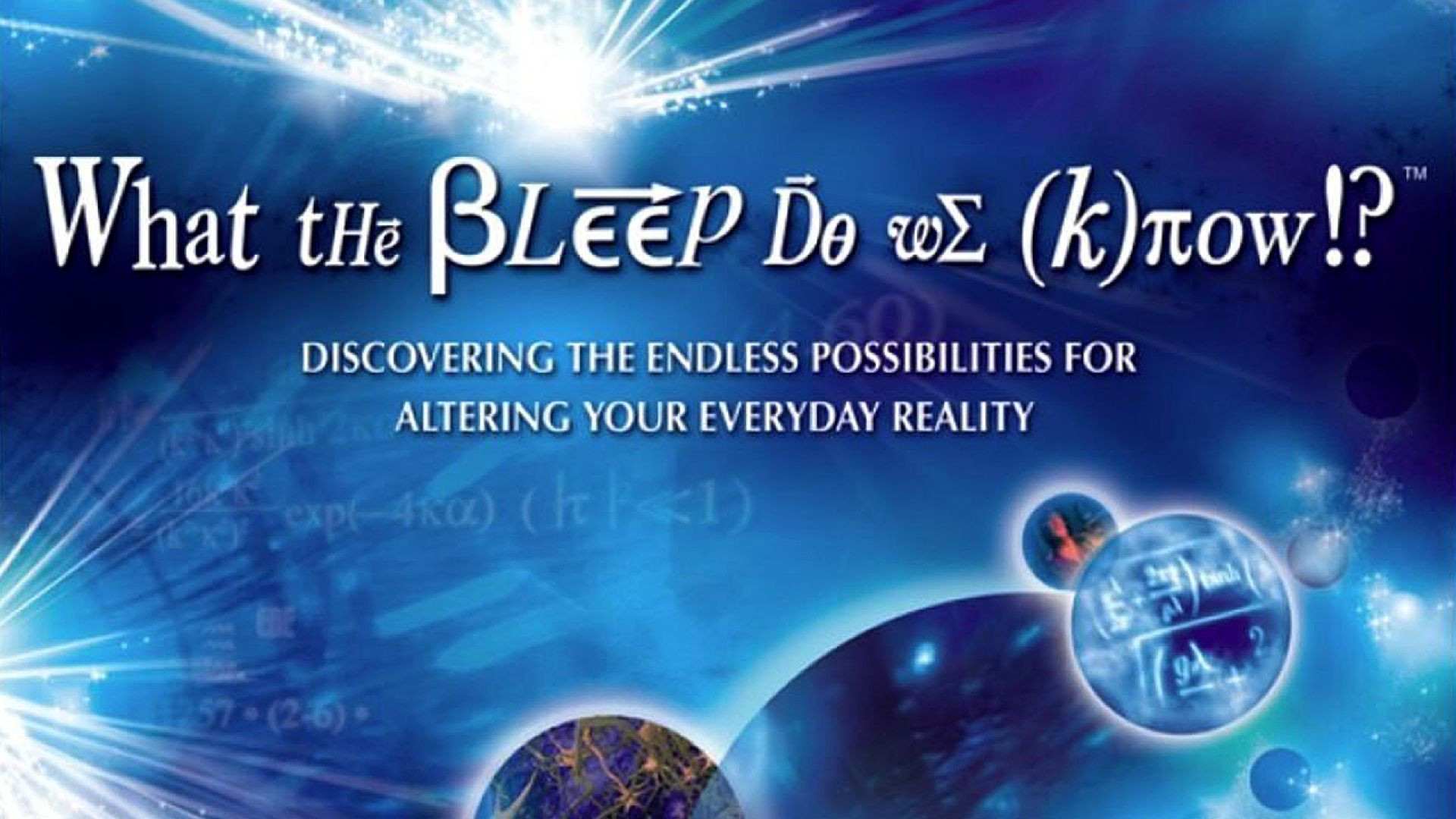
Directed by William Arntz, Betsy Chasse, and Mark Vicente, the film is an initially intriguing—and then gradually more outlandish—examination of quantum physics (“the physics of possibilities”), the theoretical brand of science that supposedly helps us understand life’s most fundamental question: What is reality? Unfortunately, the film’s answer isn’t half as interesting as those posited by The Matrix, Fight Club, or Waking Life.
A collection of talking-head physicists, philosophers, religious scholars, and mystics (all of whom are deliberately unidentified until the end credits to obscure their dubious authority) casually toss about terms like “epistemic” and “gifts of intentionality” in arguing that reality—rather than being an external force—is something we shape internally, thus meaning that what’s happening within us determines what happens around us. The ensuing, rambling discussion of quantum physics’ impact on notions of love, addiction, and Jesus is clumsily interspersed with scenes involving a fictional photographer named Amanda (Marlee Matlin) who, still smarting over her husband’s infidelity, embarks on a journey of self-discovery by learning to transcend humanity’s current perception of reality.
Engaging theories are sporadically contemplated (such as the idea that an object can exist in two places at the same time), yet by the film’s conclusion, it’s clear that the real modus operandi of these “experts” is promoting a new-agey version of spiritual enlightenment intended to replace traditional monotheism. Society’s “superstitious, backwater concept of God” is the filmmakers’ ultimate target, since it interferes with their belief that everyone is God and that all of us are “co-creating our future.” If people are truly able to construct their own destinies, then I can only hope that What the Bleep Do We Know?, with its hokey and derivative CGI, John Tesh-influenced score, and screeching electronic sound effects, will beget a future devoid of these filmmakers’ creepily cultish work.
REVIEW RESOURCE : https://www.slantmagazine.com/....film/what-the-bleep-

Seaspiracy is absolutely shocking. It’s a damning and illuminating documentary that lifts the shiny veil clinging to our oceans to expose a rotten and corrupt core. Behind the sustainable promises from big corporations and plastic straw campaigns worldwide, the real truth is left hidden. Under this plastic layer of deception though is an industry that’s literally killing our oceans.
This 90 minute documentary is an unflinching look at the damage done to our blue planet. Well-researched and hard-hitting, what begins as an examination into whaling soon spirals into so much worse. Pest control, deceptively coloured salmon and sea piracy are but a few topics discussed here, and the longer the film goes on the more horrifying the truths are.
A lot of the time buzz words like “must-see” and “shocking” are thrown around the entertainment industry and lose their credibility. Honestly though, this film deserves both those labels. Every part of this industry is mired in corruption and greed, right the way through to the non-profit organizations that serve as wolves in sheep’s clothing.
What’s particularly interesting here though is just how much the buck is passed around. No one seems able to answer simple questions and as the film progresses, this becomes more and more apparent.
This globe-trotting documentary examines all forms of ocean corruption, from salmon farms in Scotland across to Shark Fin markets in China. A lot of these scenes are shot with either shaky handheld or spy cameras, backing up the threat these filmmakers face in doing this. In fact, one scene shows the camera crew forced to scramble out a building mid-interview thanks to a police tip off.
Alongside this fly-on-the-wall approach are a lot of facts that use great comparisons to show the devastation of the damage done to our oceans. Understanding the sheer scale of this through diagrams or expository text laid over establishing shots works really well to hammer home the message.
Sure, some people will go into this and write it off as sensationalist or conspiratorial but to be honest, the fact Ali Tabrizi and his team had so many issues interviewing higher-ups to explain themselves is pretty telling.
The final 15 minutes of this documentary changes tone slightly, with a poignant, sombre reminder of what’s happening to our oceans. With the water bleached a sickly shade of red, these scenes depict a form of whaling called Grind. The sound design here in particular is harrowing, and coupled with the images themselves, make for an incredibly difficult watch.
REVIEW RESOURCE: https://www.thereviewgeek.com/....seaspiracy-movierevi

Rodney Ascher's wry and provocative Room 237 fuses fact and fiction through interviews with cultists and scholars, creating a kaleidoscopic deconstruction of Kubrick's still-controversial classic The Shining.
What is "Room 237" really about? On the surface, Rodney Ascher's documentary exhibits the theories a few obsessive fans have put forward to reveal what they think Stanley Kubrick's "The Shining" is really about. According to them, Kubrick stashed "hidden meanings" in the vacancies, hallways, ballrooms, bathrooms, walk-in storage areas and hedge-mazes of the Overlook Hotel in his 1980 horror film.
Trouble is, the "Room 237" conspirators — er, contributors — don't seem to realize that those meanings are either not hidden, not meanings or not remotely supported by the secret evidence they think they've uncovered. "Room 237" isn't film criticism, it isn't coherent analysis, but listening to fanatics go on and on about their fixations can be kind of fun. For a while, at least.
Five off-screen narrators pitch various interpretations of "The Shining," accompanied by stock footage, illustrative recreations and clips from Kubrick's filmography. For Bill Blakemore, the subject of Kubrick's "Masterpiece of Modern Horror" is the genocidal slaughter of Native Americans by white European settlers; for Geoffrey Cocks, it's about the Holocaust in Nazi-dominated Europe; for Juli Kearns, it's an exploration of an impossible, Escher-like maze called the Overlook Hotel.
John Fell Ryan has discovered some interesting juxtapositions that occur if you project two prints of "The Shining" on top of each other at the same time, with one running forward and the other running backward. Jay Weidner, who characterizes himself as a "conspiracy hunter," insists "The Shining" is Kubrick's belated, life-risking confession/apology for faking the television footage of the Apollo 11 moon landing on the sets for "2001: A Space Odyssey" at the behest of the U.S. government.
"Room 237" could easily be (mis)taken for a comedic satire of fervent movie-geekery if the theories it presents — some more cockeyed than others — hadn't appeared on the Internet years ago. That's where Ascher found the inspirations for his documentary.
It starts off with a visual trick: In a digitally modified clip from Kubrick's final film, "Eyes Wide Shut" (1999), Dr. Bill Harford (Tom Cruise) stands outside the Sonata Cafe in Greenwich Village, which is actually a set at Pinewood Studios near London (which is the source of a little in-joke: The location is identified as "EUROPE"). But instead of inspecting a display featuring his old friend, pianist Nick Nightingale, he's looking at promotional materials for "The Shining." You could say that "Room 237" is based on a similar illusion, getting us to see things in a movie that either aren't there or aren't what they appear to be.
Let's rewind: Back in 2010, Ascher made a notably similar short film called "The S From Hell," a parodic inquiry into the off-the-wall proposition that the Screen Gems logo, which appeared after episodes of popular TV series such as "Bewitched" and "The Partridge Family" from 1965 to 1974, was so frightening, it traumatized a generation of unsuspecting children. Maybe you don't recall being terrified by this or any other logo? Me, neither. But we could've repressed it.
The goofy premise of "The S from Hell" is no less unlikely than some of the blarney put forward in "Room 237." The movie doesn't judge the relative merits of its subjects' opinions, probably because that might be construed as favoritism. That's understandable. But as a result, the movie lacks examples of sound critical thinking. All we have here are do-it-yourself interactive fan games.
In "The Shining," the genial hotel manager (played by Barry Nelson) mentions that the Overlook was built on an ancient Indian burial ground — a familiar horror-movie trope. Sure enough, the hotel decor is inspired by Native American motifs, as we can plainly see. But what, then, is the movie supposedly saying about the genocide of Native Americans? That their vengeful spirits might come back and kill people at a hotel? As the saying goes, that's not subtext, it's text.
The proponents of the Holocaust and staged-moon-landing scenarios undermine their own hypotheses by backing into them. They start with extraneous information (Kubrick wanted to make a Holocaust movie but could never figure out how; nobody was in a better position than Kubrick to fake moon footage in 1969). Then they scour the nooks and crannies of "The Shining" for anything that could be construed to support, or at least reference, their chosen preconceptions.
So is the recurrence of the number 42 (on Danny's jersey; in the movie "Summer of '42" on TV) an allusion to 1942, the year of the Wannsee Conference when Nazi officials met to plan the Final Solution? What about that German typewriter? And is Danny's hand-knit Apollo 11 sweater linked to the ultra-scary Room 237 because the average distance between the Earth and the moon is 237,000 miles? Even though it isn't 237,000 miles, but let's not allow facts and a few extra zeroes to spoil a juicy conspiracy plot. What if the first word in the famous typewritten "All work and no play makes Jack a dull boy" manuscript could be read as "A11" — as in "Apollo 11"?! What if, indeed.
The double-projection trick isn't a theory at all, just a nifty experiment in randomness somewhat less remarkable than the discovery that Pink Floyd's "Dark Side of the Moon" produces some striking juxtapositions when played along with "The Wizard of Oz." Likewise, it's sorta neat that the Outlook does not have an intelligible floor plan, as it fits with the movie's "lost in the maze" motif. But there's nothing unusual about it. That's the way movie sets are usually built — in disconnected bits and pieces, not as integral units.
Kubrick's longtime assistant and collaborator Leon Vitali (who played Lord Bullingdon in "Barry Lyndon") recently said that "Room 237" had him "falling about laughing most of the time" because he knows these ideas are "absolute balderdash." The Adler typewriter, for example, belonged to Kubrick himself, and that particular model was once as commonplace as late-model iPhones.
Any movie is the product of forethought, accident and improvisation. In the end, once the film is released, the filmmakers' intentions don't really matter anymore because it belongs to the audience. At that point, if something's there, it's there. "Room 237," regrettably, isn't all there.

Citizenfour is a 2014 documentary film directed by Laura Poitras, concerning Edward Snowden and the NSA spying scandal. The film had its US premiere on October 10, 2014, at the New York Film Festival and its UK premiere on October 17, 2014, at the BFI London Film Festival.
The film features Snowden and Glenn Greenwald, and was co-produced by Poitras, Mathilde Bonnefoy, and Dirk Wilutzky, with Steven Soderbergh and others serving as executive producers. Citizenfour received critical acclaim upon release, and was the recipient of numerous accolades, including Best Documentary Feature at the 87th Academy Awards. This film is the third part to a 9/11 trilogy following My Country, My Country (2006) and The Oath (2010).
In January 2013, Laura Poitras, an American documentary film director/producer who had been working for several years on a film about monitoring programs in the United States that were the result of the September 11 attacks, receives an encrypted e-mail from a stranger who calls himself "Citizenfour." In it, he offers her inside information about illegal wiretapping practices of the US National Security Agency (NSA) and other intelligence agencies.
In June 2013, accompanied by investigative journalist Glenn Greenwald and The Guardian intelligence reporter Ewen MacAskill,[6] she travels to Hong Kong with her camera for the first meeting with "Citizenfour" in a hotel, who reveals himself as Edward Snowden. Scenes of their meeting take place in Snowden's hotel room, where he maintains his privacy. Shots of Snowden in his bed, in front of his mirror and of the hotel from a distance form the character of Snowden as a trapped political agent.
After four days of interviews, on June 9, Snowden's identity is made public at his request. As media outlets begin to discover his location at the Mira Hotel, Snowden moves into Poitras' room in an attempt to elude phone calls made to his room. Facing potential extradition and prosecution in the United States, Snowden schedules a meeting with the United Nations High Commissioner for Refugees and applies for refugee status. After Poitras believes she is being followed, she leaves Hong Kong for Berlin, Germany.
On June 21, the US government requests the Hong Kong government extradite Snowden. Snowden manages to depart from Hong Kong, but his US passport is cancelled before he can connect to Havana, stranding him in the Sheremetyevo International Airport in Moscow for 40 days. On August 1, 2013, the Russian government grants Snowden temporary asylum for a period of one year.[8] Meanwhile, Greenwald returns to his home in Rio de Janeiro and speaks publicly about United States' utilization of NSA programs for foreign surveillance. Greenwald and Poitras maintain a correspondence wherein they both express reluctance to return to the United States.
Throughout, the film offers smaller vignettes that precede and follow Snowden's Hong Kong interviews, including William Binney speaking about NSA programs, and eventually testifying before the German Parliament regarding NSA spying in Germany.
The film closes with Greenwald, Snowden and Poitras meeting once again, this time in Russia. Greenwald and Snowden discuss new emerging details on US intelligence programs, careful to only write down and not speak critical pieces of information. Greenwald tears these documents creating a pile of scraps, before slowly removing them from the table.

As long as you accept there’ll be no genuine analysis in “My Generation,” Michael Caine’s joy ride through his youth offers significant pleasures. There’s a tremendous amount of pleasure to be had in David Batty’s “My Generation,” a sloppy wet kiss to Michael Caine and British youth culture of the 1960s. Loaded with great footage from the era and accompanied by superbly cleaned-up music tracks from the Kinks, the Beatles, the Rolling Stones and many others, this love letter-as-documentary offers 85 minutes of good old fun. What it doesn’t do is posit any genuine analysis or even make a head-nod to diversity.
But this is Caine’s narrative about the unapologetic working class taking over popular culture, and the writers as well as music mogul Simon Fuller, acting as top producer, have no interest in countering their star’s gleefully empowering chronicle of his youth. Voiceover interviews with such key players of the era as Paul McCartney, Marianne Faithfull, Twiggy and Mary Quant add to the overall feast, making the film an attractive offering for all platforms. Britain in the 1950s was dull, announces Caine, though doesn’t every generation say that about the era before their own gloriously self-satisfied arrival?
What’s undeniable is the momentous shift toward youth culture beginning in the 1960s, as well as the opening up of opportunities for white working-class creative types who no longer submitted to makeovers designed to smooth out their roughness. In one of the more telling anecdotes, Caine talks about auditioning for “Zulu,” his breakthrough role, and accurately suggests that had the director, Cy Endfield, been British instead of American, Caine’s working class London accent would have eliminated any hope of being cast in the role of an upper-class officer. That’s an undeniable fact.
Far more shaky is the suggestion that the working class in the 1960s was the first generation in Britain to thumb its collective nose at convention. On-the-street interviews from the era with stuffed shirts bemoaning the appearance of long-haired men in flowery blouses expose middle-class attitudes, but the filmmakers choose to ignore the fact that the upper class has always played with transgression in ways designed to shock the bourgeoisie. What made the 1960s different was that the working class was playing the same game, and emulating “our betters” was no longer an acceptable form of behavior.
Nor was emulating our elders: Freedom from convention was the hallmark of a social revolution that impacted everything from art, music and clothing to changing concepts of morality. Of course, every Englishman knows the class system remains the key determinant of opportunity, but in the art and entertainment world, coming from the wrong side of the tracks is actually now more desirable than a boarding school certificate, and that’s definitely due to the upheavals of the 1960s. Batty divides the film into three parts, roughly corresponding to the awakening, the flourishing and the decline of 1960s pop culture.
Alongside nods to expected historic markers like the Beatles performing at Liverpool’s Cavern Club are more unanticipated moments, such as Roger Daltry talking about the profound impact of seeing Elvis perform: “For the first time in my life, I saw someone who was free.” That’s about the only time in the film there’s a mention of transatlantic influences on the British scene. From there, the documentary plunges headlong into the intoxicating psychedelic playpen of Pop Art, Vidal Sassoon haircuts, and Mary Quant micro-miniskirts, reminding audiences (or teaching them for the first time) that in the 1960s, color and pattern were transgressive and hip, unlike today’s tediously conformist black monochromaticity.
Suddenly, thanks to the British Invasion, being young and British meant you were cool, stylish and glam, tuned into the best music, clothes and art movements. Models such as Jean Shrimpton and Twiggy set new standards for beauty, and groups like the Animals, the Kinks, the Stones and of course the Beatles set the tone, guiding a generation from the innocent charm of “Love Me Do” to the raucous hunger of “(I Can’t Get No) Satisfaction.” By the end of the decade, hedonism took a darker turn.
The Vietnam War acted as a political coming of age, and the destructive nature of so much heavy drug use began to take its toll, symbolized by the death of Brian Jones and Faithfull’s near-fatal drug overdose, both in 1969. For Caine, “My Generation” is a chance to look back in nostalgic delight at his salad days, allowing him to gamely reminisce about his time as one of the “it” boys of London. He even gets to swan around in the original Aston Martin DB4 he drove in “The Italian Job.”
None of the others interviewed are seen on screen — whether that’s because the producers wanted to maintain the aura of 1960s youth, or it was the only way to get these people to talk, remains open for speculation. It’s also likely that writers Dick Clement and Ian La Frenais allowed themselves to be guided by Caine’s insistence on working-class culture, ignoring the fact that some of those included, most especially Faithfull, are from posh backgrounds. If you set aside analytical skills however, it’s easy to sit back and enjoy the wealth of archival clips accompanied by fantastic music tracks that seem to have been remastered for the occasion (lord knows how much all the music rights must have cost).
Ben Hilton’s editing successfully crams in a great deal without a sense of whiplash. Reviewed at Venice Film Festival (Out of Competition), Sept. 4, 2017. (Also in London Film Festival – Journey.) Production: (Documentary — U.K.) An XIX Entertainment presentation, in association with IM Global, of a Raymi Films production, in association with Ingenious Media. (International sales: IM Global, Los Angeles.)
Producers: Simon Fuller, Michael Caine, Dick Clement, Ian La Frenais, Fodhla Cronin O’Reilly. Executive producer: James Clayton. Co-producer: Ben Hilton. CREW: Director: David Batty. Writers: Dick Clement, Ian La Frenais. Camera (color): Ben Hodgson. Editor: Ben Hilton. Music supervisor: Tarquin Gotch. Crew: With: Michael Caine Voices of David Bailey, Twiggy, Terry O’Neill, Roger Daltrey, Marianne Faithfull, Paul McCartney, Lulu, Joan Collins, Sandie Shaw, Penelope Tree, Dudley Edwards, Mary Quant, Mim Scala, David Putnam, Barbara Hulanicki.
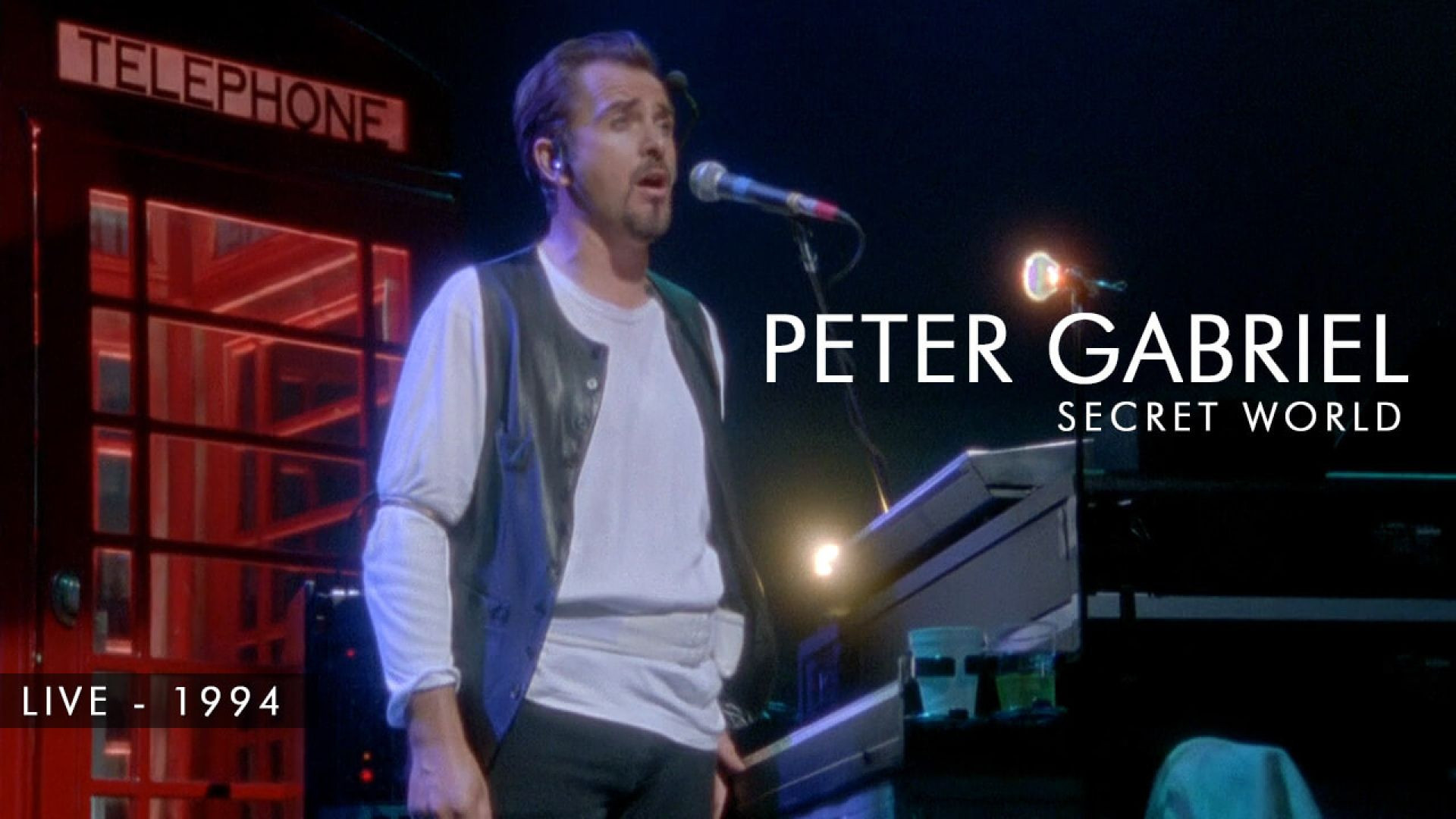
Peter Gabriel Secret World Live Full Concert - 1994 Italia
Songs list:
Come Talk To Me
Quiet Steam / Steam
Across The River
Slow Marimbas
Shaking The Tree
Blood Of Eden
San Jacinto
Kiss That Frog
Washing Of The Water
Solsbury Hill
Digging In The Dirt
Sledgehammer
Secret World
Don't Give Up
In Your Eyes

Disclaimer: We here at FOY (FollowersofYah.com also known as FOY) ministry are Not Doctors, We advise everyone to always seek the advice of a physician or other qualified health care provider with any questions regarding personal health or medical conditions. If you have or suspect that you have a medical problem or condition, please contact a qualified health care professional immediately. The Content listed represents the views and opinions of FOY ministry. The Video Content has been made available for informational and educational purposes only.
The Video Content is not intended to be a substitute for professional medical advice, diagnosis, or treatment. Always seek the advice of your physician or other qualified health provider with any questions you may have regarding a medical condition. Never disregard professional medical advice or delay in seeking it because of something you have read or seen on our site. FOY ministry hereby disclaims any and all liability to any party for any direct, indirect, implied, punitive, special, incidental or other consequential damages arising directly or indirectly from any use of the Video Content, which is provided as is, and without warranties. Whatever you decide, FOY ministry ministry is not liable for your own personal decision. Each person must consider the benefits verses disadvantages of the subject at hand.
Strikes have been removed so I can now post this here! The book, that the great prophet, Dani’el was told to seal, has been unsealed! By Yahuwah’s great mercy and kindness, through HIS Ruach Ha Qodesh, by faith in Yahushua Ha Mashiach, He has completely, revealed the fullness of the end time deception. You do not want to miss watching this. You can also order the ‘Abomination of Desolation’ on DVD order by email at emailus@FollowersofYah.com.
Disclaimer: we here at FOY, feel strongly against receiving anything that can alter one's DNA. However, with that said, we by no means can pass judgment on any individual person as Yahuwah is the Judge. One's Salvation is based on belief in Yahushua Ha Mashiach.
COPYRIGHT DISCLAIMER UNDER SECTION 107 OF THE COPYRIGHT ACT 1985, allowance is made for "fair use" for purposes such as criticism, comment, news reporting, teaching,Scholarship, and research. fair use is permitted by copyright statue that might otherwise be infringing Non Profit Educational or personal use tips the balance in favor of fair use.

This film exposes the climate alarm as an invented scare without any basis in science. It shows that mainstream studies and official data do not support the claim that we are witnessing an increase in extreme weather events – hurricanes, droughts, heatwaves, wildfires, and all the rest. It emphatically counters the claim that current temperatures and levels of atmospheric CO2 are unusually and worryingly high. On the contrary, compared to the last half billion years of earth’s history, both current temperatures and CO2 levels are extremely and unusually low. We are currently in an ice age. It also shows that there is no evidence that changing levels of CO2 (it has changed many times) have ever ‘driven’ climate change in the past.
Why then, are we told, again and again, that ‘catastrophic man-made climate change’ is an irrefutable fact? Why are we told that there is no evidence that contradicts it? Why are we told that anyone who questions ‘climate chaos’ is a ‘flat-earther’ and a ‘science-denier’?
The film explores the nature of the consensus behind climate change. It describes the origins of the climate funding bandwagon and the rise of the trillion-dollar climate industry. It describes the hundreds of thousands of jobs that depend on the climate crisis. It explains the enormous pressure on scientists and others not to question the climate alarm: the withdrawal of funds, rejection by science journals, and social ostracism.
But the climate alarm is much more than a funding and jobs bandwagon. The film explores the politics of climate. From the beginning, the climate scare was political. The culprit was free-market industrial capitalism. The solution was higher taxes and more regulation. From the start, the climate alarm appealed to and has been adopted and promoted by, those groups who favour bigger government.
This is the unspoken political divide behind the climate alarm. The climate scare appeals especially to all those in the sprawling publicly-funded establishment. This includes the largely publicly-funded Western intelligentsia, for whom climate has become a moral cause. In these circles, to criticize or question the climate alarm has become a breach of social etiquette.
The film includes interviews with many very prominent scientists, including Professor Steven Koonin (author of ‘Unsettled’, a former provost and vice-president of Caltech), Professor Dick Lindzen (formerly professor of meteorology at Harvard and MIT), Professor Will Happer (professor of physics at Princeton), Dr. John Clauser (winner of the Nobel prize in Physics in 2022), Professor Nir Shaviv (Racah Institute of Physics), professor Ross McKitrick (University of Guelph), Willie Soon and several others.
The film was written and directed by the British filmmaker Martin Durkin and is the sequel to his excellent 2007 documentary The Great Global Warming Swindle. Tom Nelson, a podcaster who has been deeply examining climate debate issues for the better part of two decades, was the producer of the film.

If you want to understand that the virus can be sent like simple email you have to watch this documentary.
Water is the key element of life, but new information is coming to light on the element which we thought we were so familiar with: information which could potentially reimagine our tree of life.
That is the belief shared by the advocates of a surprising theory called "water memory". For Prof. Luc Montagnier, water has the ability to reproduce the properties of any substance it once contained. Water would have the ability to retain a memory of the properties of the molecules.
What if Alzheimer's, Parkinson's, autism, HIV and even cancer could be treated thanks to this controversial theory?
Prof. Montagnier is President of the World Foundation for AIDS Research and Prevention, which he founded in 1983 together with Federico Mayor, former General Director of the United Nations Educational, Scientific and Cultural Organization (UNESCO).
Luc Montagnier contributed to the creation of many biotech companies in the United States and in France.
He has been awarded the CNRS Silver Medal, the Rosen Prize of Cancerology (1971), the Lasker Award (1986), the Gairdner Award (1987), the Gallien Prize (1985), the Jeantet Prize, the Prize of Japan (1988) and the King Faisal International Prize (1993), the Amsterdam Foundation Prize (1994), the Warren Alpert Prize (1998), the Prince of Asturias Prize (2000) and the introduction to the National Invention Hall of Fame (2004). He is also Grand Officer in the Order of the Légion d’Honneur and Commander in the National Order of Merit (1986).
Let me know your thoughts in the comments?

Under Justin Trudeau, Canada has sought to position itself as the global bastion of progressive politics. In my latest Telegraph documentary, seen above, I went to the former British colony to find out how Canadians are dealing with Trudeau’s radical reforms; from the promotion of gender ideology in schools and the mass legalisation of drugs, to his extreme new suicide laws and clamp downs on freedom of speech.
I began my investigation in one of the country’s most liberal cities, Vancouver. Possession of up to 2.5 grams of hard drugs, including heroin, cocaine and fentanyl, has been legalised in the city as part of a three year experiment which began in January of this year. If the aim was to combat the opioid crisis that already beset the city then it appears there is still much to be done as vast tent sites line the streets, patrolled by roaming zombie-like drug addicts.
As we filmed on Hastings Street, infamous as the epicentre of Vancouver’s homelessness crisis, I witnessed a topless man shoot a needle into his arm five feet from me. Though it wasn’t quite as bad as San Francisco, where my cameraman and I came under attack from angry vagrants, the scenes were still shocking.
It’s not just the homeless who patrol the streets of Vancouver. Chris Elston, better known online as Billboard Chris, campaigns against the imposition of gender ideology on children, whether through Canada’s education system or via dangerous operations to “transition” young adults. As his nickname suggests, Chris walks around Vancouver wearing signs protesting gender ideology, encouraging lively debates with passers-by which he puts on YouTube.
Chris kindly allowed our crew to join him on a walkabout, where we found many Canadians horrified by the use of puberty blockers in children and the promotion of biological men in women’s sports.
We did encounter some opposition of course, mostly through the odd shout or flicking of the finger. So much for Canadian politeness.
One aggressive gentleman, tall, ageing and angry, began a tirade against Chris with the rather bizarre singular message that he is “queer”.
Part of Canada’s social revolution can also be witnessed in its extreme new euthanasia laws. In 2016, the ruling Liberal Party passed legislation enabling assisted suicide for terminally ill Canadians. Next year the legislation will be expanded to include those with mental health problems. As Christianity declines across Canada, and the liberal obsession with “bodily autonomy” and “personal freedom” reaches its logical conclusion, a new dystopia is forming. As Dr Konia Trouton, a euthanasia advocate, told me, “we are an organised society but within that organisation we have to allow some freedoms and opportunities, this is not a communist system where we can try and reign that in”. The campaign group Euthanasia Prevention Coalition estimates that 13,500 people chose state-assisted suicide last year.
To prevent wokeism from spreading it is important to have a strong opposition party. Canada’s Conservatives have been historically weak in pushing back against Trudeau, however, their recently elected leader, Pierre Poilievre, has injected fresh energy into the party. Whilst there are some who still question Poillievre’s conservative credentials, his strategy seems to be working; one recent poll gave his party a twelve point lead over Trudeau’s Liberals.
However, the most successful opponents to Canada’s social revolution have so far not been politicians but members of the public. Our film highlights some of these brave individuals, including Dr Jordan Peterson, perhaps the most high-profile Canadian in the world other than the country’s leader.
During my travels I found ordinary people appalled at Canada’s surrender to drug dealers, its contempt for freedom of speech, its enforcement of gender ideology on children and a breezy willingness to terminate the lives of its own citizens. However, for all the depressing stories of people losing their jobs, or being hounded by the government, these cases were equally inspirational. Whilst Canada is a warning to the West, there are also individual messages of hope from those brave individuals fighting for their freedom.

Author and former research scientist Judy Mikovits, of TheRealDrJudy.com, spoke to Alex Jones Sunday about her experience being persecuted by the US government after she challenged the establishment’s HIV narrative and instead promoted plant-based medicine and natural immunity.
Mikovits detailed how she researched natural product therapies for viruses like HIV and discovered the virus doesn’t always lead to AIDS if a healthy immune system can be kept intact.
However, Dr. Anthony Fauci, head of the National Institutes of Allergy and Infectious Diseases at the time, buried the research, commandeered the isolated HIV virus, and used it to perform gain-of-function studies.
She also broke down the political persecution that led to her unlawful incarceration, what’s really behind the poison death shot Covid jabs, and revealed the actual way to heal naturally using remedies already provided by God.
RESOURCE: https://www.infowars.com/posts..../bombshell-dr-judy-m

Primarily known as a past life regressive therapist, Dolores Cannon reveals her experiences as an Alien and U.F.O. investigator, citing compelling cases of alien abductions and communications with E.T.s. Unaccounted time, the seeding of Earth, the E.T. cover-up, crashed U.F.O. cases, what the Greys truly are and mankind's future on the New Earth are but a few provocative topics Cannon discusses.
From the dawn of mankind, they have been here guiding us, monitoring us, perhaps helping us with our advancement, but also manipulating us to some kind of end game. No, we are not alone and never were. From the true stories of credible eyewitnesses, learn fascinating insight into the Alien Presence on Earth and what it may mean for mankind.

‘THE END OF MEDICINE’ INVESTIGATES LINK BETWEEN DISEASE AND ANIMAL CONSUMPTION
While Joaquin Phoenix and Rooney Mara have starred in many movies together, they’ve now teamed up to make a movie. The duo–who are as equally respected by Hollywood as they are by the animal rights community–lend their influence to a new feature-length investigative documentary called The End of Medicine. As executive producers, Phoenix and Mara team up with BAFTA-winning director Alex Lockwood (73 Cows) and producer Keegan Kuhn (Cowspiracy, What The Health) to expose a disturbing, dirty little secret that the food industry has been trying to conceal for decades.
In a swift 73 minutes, The End of Medicine draws attention to the underreported link between global disease–pandemics and antibiotic resistance included–and our (mis)use of animals. The film gets its momentum from whistleblower Dr. Alice Brough, a young vet who first grew intolerant toward the industry’s “acceptable” practices of animal agriculture. As we see, Dr. Brough risks her professional career and livelihood to denounce the corruption within the industry by sharing insider information about the reality of factory farming and animal disease. Through her tears, we can clearly see how distressed she is as she talks directly to the camera, remorseful for her contributions to the industry in the past.
Where to watch: ‘The End of Medicine’ is available on VOD May 10th.
While Joaquin Phoenix and Rooney Mara have starred in many movies together, they’ve now teamed up to make a movie. The duo–who are as equally respected by Hollywood as they are by the animal rights community–lend their influence to a new feature-length investigative documentary called The End of Medicine. As executive producers, Phoenix and Mara team up with BAFTA-winning director Alex Lockwood (73 Cows) and producer Keegan Kuhn (Cowspiracy, What The Health) to expose a disturbing, dirty little secret that the food industry has been trying to conceal for decades.
In a swift 73 minutes, The End of Medicine draws attention to the underreported link between global disease–pandemics and antibiotic resistance included–and our (mis)use of animals. The film gets its momentum from whistleblower Dr. Alice Brough, a young vet who first grew intolerant toward the industry’s “acceptable” practices of animal agriculture. As we see, Dr. Brough risks her professional career and livelihood to denounce the corruption within the industry by sharing insider information about the reality of factory farming and animal disease. Through her tears, we can clearly see how distressed she is as she talks directly to the camera, remorseful for her contributions to the industry in the past.
In typical call-to-action-type documentaries, The End of Medicine provides an overwhelming number of facts that are meant to shock the viewer into making immediate lifestyle changes. Industry insiders, government advisors, politicians, scientists, and leading doctors share unnerving statistics that at times, feel more hopeless than optimistic.
One claim that caused me to sit up a little straighter was hearing that 3 out of 4 emerging infectious diseases come from an animal source. This tends to happen because an animal’s immune system is lowered when they’re stressed, and they’re stressed because they’re so densely packed in cages in unsanitary conditions. It’s easy for the animal, then, to catch an infection and spread it to the rest of their cage-mates and eventually, the humans who consume them. Not surprisingly, COVID was used as an example: We socially distance ourselves from other sick humans but are doing the exact opposite to animals. This film asks, “Why?”
The End of Medicine has one goal in mind, and that is to get its audience to think twice about consuming animal products. Ideally, Phoenix and Mara would be able to convince all of us to go completely vegan (but it may take a few more documentaries for that to happen). While the note the film ends on isn’t the most optimistic in tone, aside from the standard “transform yourself to transform the world”, its intentions are pure and worthwhile. Films like these are important, and if The End of Medicine causes you to pause before ordering the burger–even for a moment–then it’s done its job.
REVIEW RESOURCE: https://cinemacy.com/the-end-of-medicine-review/

With unfettered access to the Zappa family trust and all archival footage, ZAPPA explores the private life behind the mammoth musical career that never shied away from the political turbulence of its time.
Alex Winter’s assembly features appearances by Frank’s widow Gail Zappa and several of Frank’s musical collaborators including Mike Keneally, Ian Underwood, Steve Vai, Pamela Des Barres, Bunk Gardner, David Harrington, Scott Thunes, Ruth Underwood, Ray White and others.
Directed by Alex Winter
http://www.thezappamovie.com/
For more great titles, check out Magnolia Selects:
https://www.magnoliaselects.com
'Frank didn't adhere to any movements': behind the Zappa documentary (The Guardian)

The Israeli military’s reported use of an untested and undisclosed artificial intelligence-powered database to identify targets for its bombing campaign in Gaza has alarmed human rights and technology experts who said it could amount to “war crimes”.
The Israeli-Palestinian publication +972 Magazine and Hebrew-language media outlet Local Call reported recently that the Israeli army was isolating and identifying thousands of Palestinians as potential bombing targets using an AI-assisted targeting system called Lavender.

Under any circumstances should you watch this movie if you want to stay in your pleasant state of hypnosis, which you allowed yourself to be implanted by the tyranny and totalitarianism of the psychopathic elites of the modern world.
The Great Awakening is the third installment of the Plandemic series. This documentary experience assembles forbidden puzzle pieces to reveal the big picture of what's really happening in America and beyond. The Great Awakening is intended to be a lighthouse to guide us out of the storm and into a brighter future.
https://plandemicseries.com/wa....tch-the-great-awaken

In the spring of 2019 we started creating a short film series, “PIONEERS OF SCIENCE” with the Sacopee Valley Middle’s School’s 8th grade science class taught by Steve Bridges about Wi-Fi and its potential health risks.
The students have been amazing to work with and the first experiment we did exposing cress seeds to Wi-Fi was incredibly powerful and thought provoking. We’re looking forward to running a number of experiments and documenting our different discoveries.
RESOURCE: http://pioneersofscience.org/

See how the US media has little to do with news, and a lot to do with dividing the people and controlling our minds.
RESOURCE: https://plandemicseries.com/the-media/
