Top videos

his piece was written during the 2023 WGA and SAG-AFTRA strikes. Without the labour of the writers and actors currently on strike, the movie being reviewed here wouldn’t exist.
As a child, I would often hear my grandfather say that with the creation of the atomic bomb, there wouldn’t be any world wars anymore. There would only be smaller wars. So far, he’s been right, although the prospect of a country using an atomic weapon on another has never left us. Even the threat of a so-called “dirty bomb” being used by a rogue organisation is a very real possibility that many governments fear and presumably have developed contingency plans for.
When University of California, Berkeley physicist J. Robert Oppenheimer was recruited to head up the Manhattan Project, America’s program to design and build the world’s first atomic bomb, he, like many others, had visions of war being a thing of the past. That view changed, however, when he saw how destructive his creation turned out to be. The two atomic bombs that were dropped over Hiroshima and Nagasaki incinerated both cities and killed between 150,000 and 225,000 people, with about half of those deaths occurring on the first day. Think about that. It means that about 100,000 people died of radiation burns and cancers in the days, months and years after the bombings took place. One can argue that the bombings hastened the end of the war with Japan but at what cost?
Coinciding with the release of Christopher Nolan’s new film, OPPENHEIMER, NBC in the US has released a feature-length documentary entitled TO END ALL WAR: OPPENHEIMER & THE ATOMIC BOMB. It follows Oppenheimer’s rise to the pinnacle of heroism in the eyes of most Americans and his subsequent fall.
Little known to most people these days, Oppenheimer was a tragic figure. Historians agree that his contributions to theoretical physics should have earned him a Nobel Prize if not for two things: the destructive nature of the bomb — the antithesis of why Alfred Nobel created the prize in the first place — and his outspoken opposition to America continuing its development of other weapons of mass destruction, the latter of which put him solidly in the crosshairs of Senator Joe McCarthy’s House Un-American Activities Committee (HUAC).
Prime Time Emmy Award-winning director Christopher Cassel (ROME) examines Oppenheimer’s early years as well as the legacy he left behind with a mix of archival footage, soundbites, animated scenes, heartbreaking footage of the blasts’ survivors, and interviews from Bill Nye (the Science Guy), Hiroshima survivor Hideko Tamura, grandson Charles Oppenheimer and Christopher Nolan among others. (If you’re wondering why Nolan would appear in this documentary, Universal Pictures, which is distributing his film worldwide, is the sister company of NBC.)
I now seen OPPENHEIMER and TO END ALL WAR complements the film rather than takes away from it. It’s a fascinating look at a complicated and tormented man at a time when his country wanted a hero more than it wanted a moral compass.
REVIEW RESOURCE: https://howardforfilm.com/2023..../07/18/movie-review-

110v & 230v Free Energy Generator.
After 7 months of research and development we have created the new "Liberty Engine 2.0". This new free, free and infinite energy motor is made from microwave transformers and a 220v motor, and doubles the power of its previous model. It also has more improvements such as its futuristic design, we have eliminated the transmission through pulleys and belt to reduce friction, noise and vibrations. We have also added the manual pull start that you have recommended so much in the comments, we have added a rotor with a special alloy to eliminate Eddy currents, and thus, eliminate magnetic braking when connecting electrical charges.
In order for the voltage output to be 110 volts instead of 230 volts, we must manufacture it with microwave transformers and a 110 volt motor.
We hope you like it. If so, subscribe, like the video and leave your opinion in the comments. In this way we will be able to continue researching and creating new ways of generating energy.

Federal Reserve, Bank Of England, NWO, Rockefeller, Goldman Sachs, Grat Reset, Baksters, Banking Cartels, Depopulation, Mind Control, Genocide
Though Bill Gates, Warren Buffet, and Carlos Slim are supposedly "the richest men in the world," their combined wealth of $180 billion would qualify them as mere servants for the House of Rothschild.
Rothschild owns the Bank of England and the London gold bullion exchange where Rothschild sets the daily international market price for gold. Rothschild owns the gold and diamond mines of S. Africa and major extractive industries such as Rio Tinto and British Petroleum.
Rothschild financed England and France in the Napoleonic wars. Rothschild knew who won the Battle of Waterloo a day before the King of England and British investors. Rothschild caused a selling panic in the London bond "consul" market intimating to investors that England lost to Napoleon. Bonds issued by the Bank of England to finance the war crashed and sold for pennies on the dollar.
Rothschild sold to drive the price down and then bought all the bonds back at rock bottom prices. The next day when word of England's victory over Napoleon hit the market, bond prices soared. Rothschild made 40 times his investment in one day on insider knowledge. Rothschild also made 30 percent interest on the gold he loaned to the kings to fight each other.
The king issued bonds as a debt obligation to Rothschild to be paid by future taxes on British citizens. The ensuing debt was so much that Rothschild was able to take over ownership of the Bank of England, which subsequently financed the mercenary German Hessians to fight the American revolutionaries in colonial America because Washington issued its own money called greenbacks. It wasn't about tea.
Rothschild owns major European Central Banks: England, Switzerland, France, Germany, and Belgium – central bank for the Euro. Rothschild partnered with the original seven American families who became the regional depository banks in the US Federal Reserve. The Bush family and J.P. Morgan are the political and financial dynasties evolved from their original ownership of the Federal Reserve. Political propaganda confuses American citizens into thinking the U.S. government owns and prints its own money. Not so. Bush, J.P. Morgan and five other banking family institutions own the Federal Reserve in partnership with Rothschild.
Rothschild owns Reuters News Service, which bought the Associated Press. Rothschild owns or virtually controls every major media outlet in America, Europe and Israel. Rothschild controls the message of who really owns $500 trillion of hidden untaxed wealth equal to half of annual world GDP.
https://www.tabletmag.com/sect....ions/arts-letters/ar
https://paulsalmons.associates..../blog/conspiracy-the

Documentary filmmakers Joe Berlinger and Bruce Sinofsky had begun a professional relationship with Metallica while making their 1996 film Paradise Lost: The Child Murders at Robin Hood Hills, about the West Memphis Three. Moved by the story of the West Memphis Three, Metallica, who normally did not allow their music to be used in films, allowed Berlinger and Sinofsky to use their songs in Paradise Lost for free.
The band and the directors kept in touch, discussing the possibility of working on a larger project together. Berlinger split from Sinofsky to direct Book of Shadows: Blair Witch 2 (2000), which was critically panned and made little money. After this experience, he contacted Sinofsky and Metallica about revisiting their plans for a film.
The year 2000 had been, in the words of bassist Jason Newsted, "possibly the highest-profile year for Metallica ever." The band had released the live album S&M in late 1999, then played a New Year's Eve show with Ted Nugent, Sevendust, and Kid Rock. In February they won a Grammy Award for Best Hard Rock Performance for their cover version of "Whiskey in the Jar" (from their 1998 covers album Garage Inc.).
The following month, they filed a highly-publicized lawsuit against file sharing service Napster. In May they released the new single "I Disappear" from the Mission: Impossible 2 soundtrack; they performed the song at the 2000 MTV Movie Awards in June, and its music video was nominated in five categories at the 2000 MTV Video Music Awards that September. Metallica spent June through August on the Summer Sanitarium Tour, playing 20 shows with Korn, Kid Rock, Powerman 5000, and System of a Down. During the tour, singer and rhythm guitarist James Hetfield was injured in a jet ski accident and had to miss three shows.
Bassist Jason Newsted, pictured in 2013. His departure from Metallica, and its after-effects, form part of the narrative of Some Kind of Monster.
The band took a break beginning that fall, which turned into the longest hiatus from touring and recording they had ever taken.

The first authorized documentary film exploring David Icke's work and life. He is the famed conspiracy theorist, known as the “mad man” who has been proved right time and time again.
David Icke has been warning the public for almost three decades about the coming global Orwellian state in which a tiny few would enslave humanity through New World Order tactics. Methods such as control of finance, government, media, and a military-police Gestapo overseeing 24/7 surveillance of a microchipped population. He has said that “physical reality is an illusion" and that the "world" really is a holographic simulation created by a non-human force to lockdown human perception in ongoing servitude.
He has been subjected to decades of ridicule and dismissal over his theories. However, now his books are read all over the globe and his speaking events are watched by thousands. Why? Because what he foretold is playing out in world events and even some mainstream scientists are concluding that reality is indeed a simulation or "Matrix."
REVIEW RESOURCE: https://www.gaia.com/video/ren....egade-life-story-dav

This documentary looks inside the life of a high-powered music publicist who became a techno-age philosopher.
For the past 20 years, in his second career as a best-selling author, Howard Bloom has been grappling with the big questions, all of which can be boiled down to, as he puts it here, “What does the universe want from you and me?” Bloom has, in the pre-Covid-19 world chronicled in this documentary about him, a strict routine that helps him in this discipline.
It includes morning exercise and consulting a list of reminders of what to take with him when he ventures out of his Brooklyn brownstone. It also involves a staggering number of medications, which he needs to combat his chronic fatigue syndrome, which struck him in 1988 and left him unable to step out of his bed, let alone his apartment, for many years.
Directed by Charlie Hoxie, “The Grand Unified Theory” is a moderately engaging documentary that credibly portrays Bloom’s indefatigability. He speaks of his aspiration to be a “24 hour-a-day information processing device” and defends his auto-didacticism by saying “Grad school looked like Auschwitz for the mind.” That eyebrow-raising simile is emblematic of Bloom’s bluff offhandedness, which likely served him well in his first career as a high-profile music publicist. (Recalling his tenure representing Run-DMC, he says, “We made rap.” Kurtis Blow and others might like a word.)
The movie spends more time on Bloom’s personality than it does on the ideas promulgated in such volumes as “The Lucifer Principle,” for which the actor Jeff Bridges contributes an onscreen blurb. And when Bloom confides his plan to let a Dubai-based fitness instructor and gym entrepreneur handle his archives, we get into what looks like some P.T. Barnum territory.
REVIEW RESOURCE: https://www.nytimes.com/2020/0....7/21/movies/the-gran

Werner Herzog, Documentary, Timothy Treadwell, Alaska, Tragedy, Tragicomedy, Home Video, Nature
Tragicomedy is an overworked word. Yet nothing else will do. Werner Herzog, that connoisseur of extreme figures in far-off places, has made an inspired documentary about the gonzo naturalist Timothy Treadwell, who in 2003 ended up as lunch for the bears he lived with in the remote Alaskan wilderness.
It is poignant, it is beautiful, and it is absolutely hilarious. Herzog didn't even have much work to do, what's more, because Treadwell - gifted, untrained film-maker that he was - had done almost everything himself, leaving behind hundreds of hours of videotape that he had shot at extreme and indeed fatal risk to himself. They contain sublime, dramatic shots of the bears and footage of his own mad and posturing rants to camera, wearing combats and a bandana - part surfer-dude, part drama-queen. Poor Mr Treadwell. He loved those bears. And they loved him. Yum, yum!
Timothy Treadwell was a mixed-up kid from Long Island in the US who wanted to be an actor. He auditioned for Cheers, but the shock and disappointment of coming second to Woody Harrelson sent him over the edge into drink and drug crises. He came out the other side clean and sober, but with a new passion: the grizzly bears of Alaska. Every summer, he went camping out there with his video camera and his attitude problem, regularly breaking the US park rangers' rule not to come within 100 yards of a bear. Timothy got up close and personal, giving them cute names like "Mr Chocolate" and "Sgt Brown", patting them on the nose, and becoming obsessed with gaining the bears' respect for his courage in doing so. His opening rant to camera is a comic classic, influenced, I very much suspect, by Dennis Hopper in Apocalypse Now: "I am a kind warrior! I will not die at their claws and paws! I will be a master!"
Bizarrely, his macho extreme-sports persona often alternates with something screamingly camp. Treadwell yoo-hoos wildly like Robin Williams at the bears who lope up to him: "Oh hi! Hiya! Oh he's a big bear! He's a surly bear!" And Treadwell is often very funny - a reality TV natural who never got his own show. There are too many choice moments to describe here, but among the classics is his sudden zooming-in on an immobile bumble bee on a flower, which he tearfully describes: "Isn't this so sad? A bumble-bee expired while it was doing the pollen thing. It's beautiful . . . it's sad . . . it's tragic . . . it's . . . WAIT! The bee just MOVED! Is it . . . is it just SLEEPING?" Later, Treadwell films a full-on macho-bear fight between Micky and Sgt Brown over a female called Saturn, whom Treadwell describes as the "Michelle Pfeiffer of bears".
His mission was to teach the world about these animals, and this he certainly did, according to his lights, touring schools and giving illustrated talks to kids without accepting a fee. But he also angrily claimed, in some of his looniest soliloquies, that he was "protecting" the bears from poachers or even the federal authorities. The awful truth was that he did not add anything to our knowledge of bears, and that any supposed danger these animals were in, living as they did in a protected national park, existed only in Treadwell's over-heated, self-dramatising imagination.
Treadwell's over-the-top persona is in contrast to the cool, deadpan drone of Herzog himself, who pays tribute to his intuitive skills as a film-maker, but repudiates Treadwell's Disneyfied view of nature, seeing in it only colossal coldness and indifference. Herzog appears on camera just once, listening through headphones to Treadwell's final screams - and those of his luckless girlfriend - as they are both eaten. It is only audio, as Treadwell was attacked before he could remove the lens-cap; in a masterstroke of restraint, Herzog does not let us hear this sound, and sorrowfully advises Treadwell's former girlfriend, Jewel, to burn the tape. I wonder if she has.
Was Timothy Treadwell an inspired radical operating outside the academic naturalist establishment - or a pain in the neck with personal issues? A little of both, of course. He was certainly a brilliant performer and director who, by crossing the taboo line (by as it were impaling himself on the taboo line's barbed wire) vividly demonstrated the alien-ness of nature, and therefore its strange and terrible beauty, more than anything I've ever seen by David Attenborough. It is a superb documentary, because Treadwell has not been coerced or set up; he was enough of an amateur to be relaxed and unselfconscious, yet enough of a professional to generate all this outstanding footage, and quite rightly Herzog declines to patronise or make fun of him. If we didn't already know Timothy Treadwell's awful fate, it would be enough to say: a star is born.
REVIEW RESOURCE: https://www.theguardian.com/culture/2006/feb/03/1

A provocative look at what it takes to hide a multi-trillion dollar Secret Space Program from the public and the implications this has for humanity.
Featuring: David Wilcock, Corey Goode, John Desouza, Niara Isley, Jordan Sather, and more.
On September 10th 2001 Secretary of Defense Donald Rumsfeld announced that $2.3 trillion dollars could not be accounted for within Department of Defense expenditures. The very next day the Pentagon’s budget analyst’s office was destroyed in the 9/11 attack. The mystery remains: Where are the missing trillions Above Majestic is a shocking and provocative look at what it would take to hide a multi-trillion-dollar Secret Space Program (a clandestine group of elite military and corporate figureheads charged with reverse-engineering extraterrestrial technology also known as “Majestic 12”) from the public and the implications this would have for humanity.
Viewers will be guided through a deep dive into the origins, technologies, history, cover ups, conspiracies, testimony and research that goes beyond and Above Majestic. Featuring some the most prominent and prolific authors, researchers, whistle-blowers and disseminators in the movement for Truth and Full Disclosure. This includes David Wilcock, Corey Goode, John Desouza, William Tompkins, David Adair, Laura Eisenhower, Niara Isley, and Jordan Sather.

Facebook has a director of social good. She is called Hema and if she has a surname, we weren’t privy to it. The BBC’s Horizon team, as if bewitched at being granted unprecedented access to the social network, bowed to its ethos by captioning interviewees by first name only. But access is like sex: it’s not what you have, but what you do with it that matters.
We met David, the director of harmful behaviour (tough gig, if his task is to stop it, rather than enable it), Monika, who is head of global policy management, and Vlad, Facebook’s head of artificial intelligence, though he will always be The Impaler to me. Sadly, we didn’t get to see Nick, but David Cameron’s former fig leaf has become Mark Zuckerberg’s now he is Facebook’s vice-president of global affairs. Mention Cleggmania in Menlo Park and nobody will know what you are on about.
By rolling over and waving its paws in this way, Horizon abolished critical distance from the global techno-oligarchy with 3.1 billion users and pretensions to ensnare the rest of us. (Facebook is building eight more data centres in the next few years with the aim of doubling storage to accommodate our data.) It put us on chummy terms with the outfit at a vexed moment. Can it change after last week’s $5bn (£4bn) fine for privacy violations in the Cambridge Analytica data breach?
In a meta sense, that was fitting: murdering distance and importuning strangers with simulations of friendliness is Facebook’s MO. It is why revenue exceeded $55bn last year. In another sense, though, this documentary almost amounted to an hour-long commercial for which Zuckerberg didn’t pay.
We witnessed how Facebook is ostensibly striving to use technical fixes to annihilate the human bugs out there – the scammers, hatemongers, sextortioners, e-groomers, Nazis, hackers and black marketeers. This was fascinating in its own right. Can artificial intelligence be used to detect other artificial intelligences posing as humans? How can hate speech by emoji be eliminated?
Fascinating, too, was the cult-like induction ceremony for incoming engineers, tens of thousands of whom are being hired, to ensure Facebook no longer has difficult years like 2018. Soon, they will join the Facebook faithful. Why are there so many balloons in Facebook offices? Because staff have two birthdays, the second celebrating when they joined this evangelising outfit.
“We’re not a company that is designed to make money,” Kyle, director of product, told a room of so-called Newbs in London. No one so much as rolled an eye. “That means every product we make is tuned for ‘does it do good in the world?’” he continued. But what is good? Maybe connecting the world to Facebook, monetising data and believing both are self-evidently good are the problems.
Facebook treats its difficulties as external ones and its task is to seal itself from them. But the corruption is inside, part of the very organisation’s ethos. It is Horror Movie 101. Everyone interviewed here was, as it were, wearing Clegg’s fig leaf to hide that unacceptable truth. “We’re a community that is designed to create communities and let those communities make a difference in the world,” Kyle added.
But Facebook is a business not a community, and when it creates communities they sometimes make a difference in a bad way. “We don’t tolerate dicks,” said Jonny, head of internal communications. Instead, Facebook enables them. Tommy Robinson was jailed earlier this month for live streaming, via Facebook, defendants arriving at court in a sexual grooming trial.
One critic complained about how Facebook had “destabled democracy”. Horizon needed more eloquent dissenters. Maybe she meant that if Facebook is a horse and democracy is a door, the former has bolted and the latter is coming off its hinges. It was hard to be sure.
Back to the commercial. Hema told how her father, who had liver cancer, lost a litre of blood an hour. If there had been an online facility matching blood supply to demand, he need not have died so quickly.
So she made it her mission to establish just that facility for 70 countries where blood transfusions don’t happen because of supply problems. Cut to her team, thrilled that 11 million users have signed up to its blood market. We learned later, though, this initiative enables a black market for blood in India. An unintentional consequence, perhaps, but given earlier online scams, a foreseeable one.
The Horizon team never met Hema’s opposite number, the director of social bad. Chet (no surname) works in a basement tasked with reversing what happened in Facebook’s difficult 2018. Not the data breaches or live-streamed mass murder in Christchurch, but the really unacceptable thing, namely how 20% was slashed from the value of Facebook shares on news that its ad revenue per user was declining and user growth slowing. Such things can never happen again, Chet realises.
Fake news. Facebook has no director of social bad. No Chet in a basement. Nobody in the social network is tasked with squeezing more money from its users. Facebook is all good.
REVIEW RESOURCE: https://www.theguardian.com/tv....-and-radio/2019/jul/

In an interview with Joe Rogan, Dr. Robert Malone, mRNA vaccine expert and outspoken critic of our pandemic response, delivered a powerful message to the world. Yes, it’s three hours long, and yes, it’s worth every minute.
Something monumentally important happened in the closing days of 2021.
Joe Rogan, host of the widely viewed “Joe Rogan Experience” podcast, interviewed one of the world’s most qualified and unbiased individuals about the safety and efficacy of the COVID-19 vaccines now deployed upon nearly 4 billion human beings.
Dr. Robert Malone, originally an academic pathologist, has run more than 100 clinical trials mostly in the vaccine and drug repurposing spaces.
He has been involved in nearly every infectious disease outbreak since the AIDS epidemic, has worked for the National Institutes of Health awarding millions of dollars in contracts for vaccines and biodefense, and spent “countless hours” at Centers for Disease Control and Prevention Advisory Committee for Immunization Practices meetings.
Malone works closely with the Defense Threat Reduction Agency, knows Dr. Anthony Fauci personally and is possibly best known for his instrumental work in developing the platform for mRNA-based vaccine technologies more than 30 years ago.
On Dec. 30, 2021, Malone and Rogan sat down in Rogan’s studio in Austin, Texas, and recorded a riveting three-hour conversation.
Rogan stands alone as an independent voice outside of corporate media that is able to reach a politically and ideologically diverse audience of 11 million or more per episode.
Similarly, Malone is an outspoken critic of vaccine mandates who represents the opinion of a large and growing number of researchers and clinicians who believe our approach to the pandemic has been poorly conceived and stands in opposition to basic tenets of immunology, epidemiology and emerging real-world data.
It was clear both were prepared for the encounter. Rogan reported he had been following the doctor’s tweets, has been reading everything Malone has been writing and was clearly versed in the latest and most salient scientific findings.
BUY TODAY: Robert F. Kennedy, Jr.'s New Book — 'The Real Anthony Fauci'
Malone, though honed by countless appearances on various platforms, admitted this interview was special because of its potential impact on public opinion.
The conversation opened with Malone summarizing his bonafides and then describing his approach to engaging his audiences.
“I try really hard to get people the information and help them to think, not tell them what to think,” Malone said.
Malone was true to his method throughout, being careful to identify fact from speculation, noting what is observed without assuming intent while helping Rogan explore the rabbit holes that we inevitably encounter when choosing to look just a bit further beyond what has become socially acceptable.
RESOURCE: https://childrenshealthdefense.....org/defender/joe-ro
VIDEOCAST: Joe Rogan Experience #1575
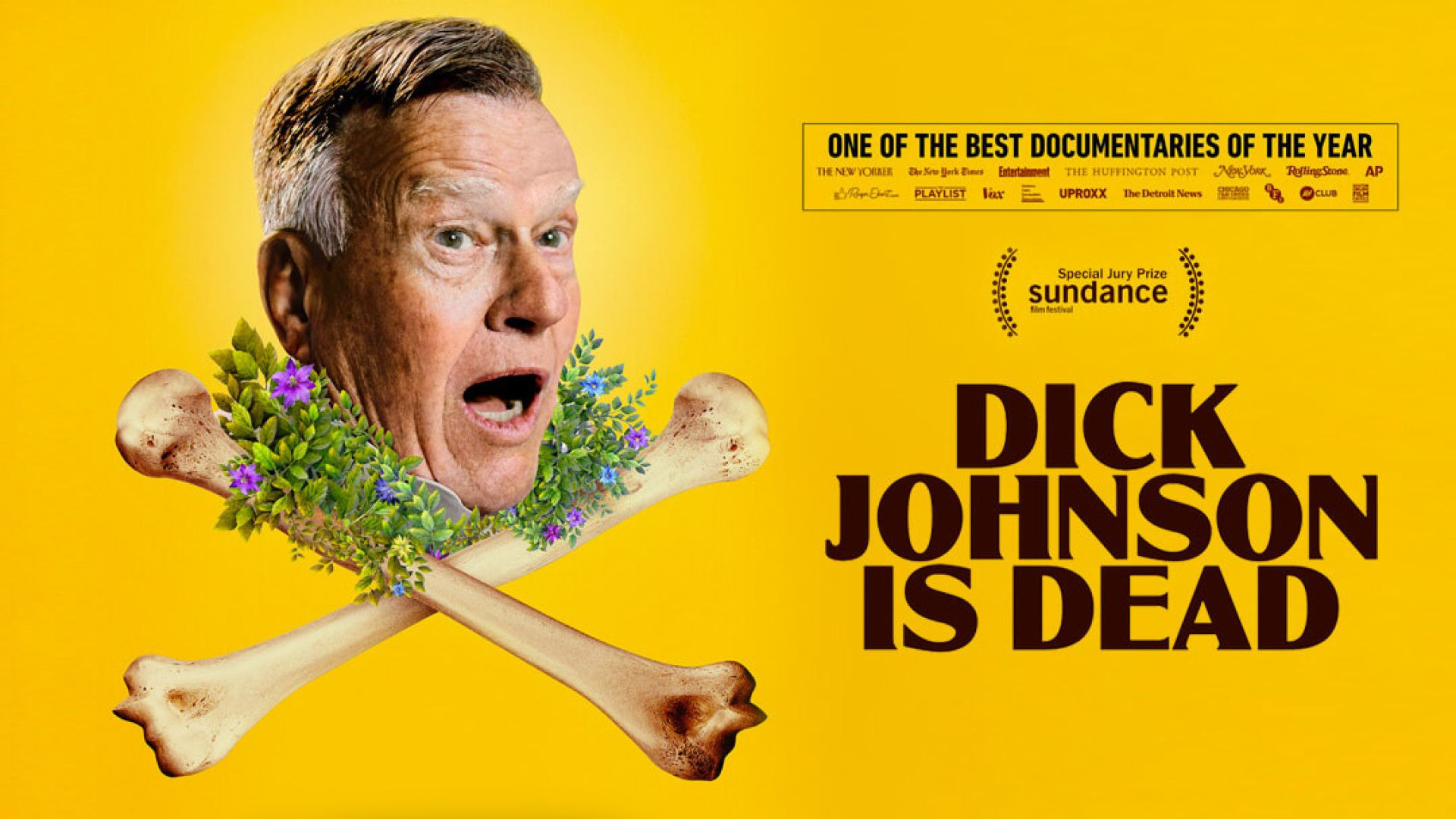
Dick Johnson Is Dead is a 2020 American documentary film directed by Kirsten Johnson and co-written by Johnson and Nels Bangerter.
A lifetime of making documentaries has convinced award-winning filmmaker Kirsten Johnson of the power of the real. But now she’s ready to use every escapist movie-making trick in the book — staging inventive and fantastical ways for her 86-year-old psychiatrist father to die while hoping that cinema might help her bend time, laugh at pain and keep her father alive forever.
The darkly funny and wildly imaginative DICK JOHNSON IS DEAD is a love letter from a daughter to a father, creatively blending fact and fiction to create a celebratory exploration of how movies give us the tools to grapple with life’s profundity. DICK JOHNSON IS DEAD was filmed, produced and directed by Kirsten Johnson (Cameraperson), produced by Katy Chevigny and Marilyn Ness, co-produced by Maureen A. Ryan and executive produced by Megan Ellison.
Cast:
Kirsten Johnson
Charles Richard "Dick" Johnson
Development:
Director Kirsten Johnson at the Miami Film Festival
Kirsten Johnson was inspired to make the film after having a dream in which "there was a man in a casket and he sat up and said, 'I'm Dick Johnson and I'm not dead yet'". When she pitched the idea to her father, she asked him, "Dad, what if we make a movie where we kill you over and over again until you really die? And he laughed".
The film incorporates Johnson family photographs and home movies, including that of Richard Johnson's wife who died from Alzheimer's disease in 2007.
Release:
The film premiered on January 25, 2020 at the 2020 Sundance Film Festival. It was released on October 2, 2020 via Netflix.
RESOURCE: www.dickjohnsonisdead.com
Evidence of a mysterious medieval famine leads researchers on a quest for one of the deadliest volcanoes in human history.
Follow a team of volcano sleuths as they embark on a worldwide hunt for an elusive volcanic mega-eruption that plunged medieval Earth into a deep freeze. The mystery begins when archaeologists find a hastily dug mass grave of 4,000 men, women, and children in London.
At first they assume it’s a plague pit from the Black Death, but when they date the bones, they turn out to be too old by a century. So what killed off these families? The chronicles of that time describe a run of wild weather that devastated crops and spread famine across Europe.
NOVA’s expert team looks for the signature of a volcanic eruption big enough to have blasted a huge cloud of ash and sulfuric acid into the atmosphere, which chilled the entire planet. From Greenland to Antarctica, the team finds telltale “fingerprints” in ice and soil layers until, finally, they narrow down the culprit to a smoldering crater on a remote Indonesian island.
Nearly 750 years ago, this volcano’s colossal explosion shot a million tons of rock and ash every second into the atmosphere. Across the globe, it turned summer into winter. What would happen if another such cataclysm struck again today?
RESOURCE: https://www.pbs.org/wgbh/nova/....video/killer-volcano

The plandemic continues, but its origins are still a nefarious mystery. How did the world get sick, how did Covid really spread, and did the Satanic elite tell the world about this bioweapon ahead of time? Dr. Bryan Ardis (www.ardisantidote.com) has unveiled a shocking connection between this pandemic and the eternal battle of good and evil which began in the Garden of Eden.
Version with Polish subs here: https://rumble.com/v10qo1a-sfj....nasjfbaf-svd-npl.htm
(Thanks for Andy Choinski)
In this Stew Peters Network, exclusive, Director Stew Peters, award-winning filmmaker Nicholas Stumphauzer and Executive Producer Lauren Witzke bring to light a truth satan himself has fought to suppress.
Visit http://ardisantidote.com/ to learn how to protect you and your loved ones during this biological war.
Get Dr. Zelenko's Anti-Shedding Treatment, NOW AVAILABLE FOR KIDS: http://zStackProtocol.com

A very important public speech by a doctor with 25 years of medical internship in several specialisations and an expert in the field of vaccines. (June 2021)
Senate committee hearings and other Capitol events are posted to this page soon after they are announced, and removed at the end of the day. You are invited to revisit this page often for the most current version. For links to individual Senate committee websites, please visit the Senate's Committee portal.
For live, streaming video broadcasts of committee hearings and other events within the Capitol complex you may visit the Senate Live Video Broadcasts page. Official Senate hearings and events are archived and can be accessed from the Senate Audio/Video Archives page or from the individual committee pages.
Events listed on this page will be carried live on the Senate Live Broadcasts page unless otherwise noted. Due to technical limitations, most out-of-town committee hearings and all "desk meetings" held on the Senate floor can not be carried live. For such events, audio recordings will be posted to the main Audio/Video Archives, as well as the relevant committee pages, as soon as possible.
A complete Senate room reservation schedule may be be found at
https://roomsched.senate.texas.gov/
Original resource: https://tlcsenate.granicus.com..../MediaPlayer.php?cli

"He's an outsider. He's a maverick." Vision Films is about to release this documentary, called Banksy & The Rise of Outlaw Art, this week - available on VOD. We missed this trailer when it first debuted a few months ago, but happy to catch up with it now. Elio Espana's doc Banksy & The Rise of Outlaw Art is a look at the modern street art / graffiti culture that Banksy elevated. "Banksy, the world's most infamous street artist, whose political art, criminal stunts, and daring invasions outraged the establishment and created a revolutionary new movement while his identity remained shrouded in mystery.
[This film] finally reveals Banksy's story, from his roots in a criminal subculture to his rise as the leader of an art revolution." Don't expect Banksy's identity to actually be revealed. Not only was there Banksy's own doc Exit Through the Gift Shop (from 2010), but we also had the Banksy Does New York doc a few years ago, too.
As the world’s most infamous street artist, Banksy’s political art, criminal stunts and daring invasions have outraged the establishment for over two decades, but despite being one of the most important figures of our times, Banksy has remained an enigma, with little known about the circumstances of his life and work.
His rise coincided with the emergence of Street Art, a form of illegal, public art that evolved from the graffiti scene to change the face of cities across the world. Banksy became the leading figure in this revolutionary new movement, assembling a multi-million dollar empire and changing the way that we think about art. Through it all, however, his identity has remained shrouded in mystery… Banksy & The Rise of Outlaw Art is directed by documentary producer / filmmaker Elio Espana, director of the films Dawn of the Dead: The Grateful Dead & the Rise of the San Francisco Underground, CSNY: Fifty by Four, Feats First: The Life & Music of Lowell George, and Hamilton: One Shot to Broadway previously.

Of all the harmful misinformation spread over the past couple of years, one of the most disturbing false narratives was targeted at the Nobel Prize winning HUMAN medicine, Ivermectin.
We produced the above short film to correct the narrative and to reveal the motive behind the smear campaign against one of the safest and most effective medicines of this era. A medicine that, according to the numerous top scientists I’ve interviewed, would have ended the pandemic before it began. A medicine that could have saved countless lives.
Every medical professional I’ve spoken with stress the importance of early treatment. Myself, my family and friends use Ivermectin regularly as a preventative against all the new variants spreading throughout our immune compromised communities.
Because I believe the withholding of Ivermectin is a crime against humanity, I’ve found what I believe is one of the best places to stock up on this truly remarkable medicine. Early Treatment Meds by Seven Cells is one of the top compounding pharmacies in the country. They source only US based products - all from FDA inspected and approved facilities.
Committed to ensuring that everyone has access to the best medicines available, Early Treatment Meds has gone to great lengths to make the ordering and delivery process as easy as possible.
Simply click the yellow button on this page, then fill out their short questionnaire. Once your order is approved by a Early Treatment Meds Physician, your Ivermectin will be sent directly to your home.
Take care of yourself… and each other.
Mikki Willis
Father, Filmmaker
RESOURCE: https://thetruthaboutivermectin.com

Stanley Kubrick: A Life in Pictures is a 2001 documentary about the life and work of Stanley Kubrick, famed film director, made by his long-time assistant and brother-in-law Jan Harlan. Its running time is 142 minutes long, it consists of several 15-minute chapters, each detailing the making of one of his films – and two more showing his childhood and life.
Jan Harlan got many of Kubrick's collaborators for interviews, including Tom Cruise, Nicole Kidman, Keir Dullea, Arthur C. Clarke, Malcolm McDowell, Peter Ustinov, Jack Nicholson, György Ligeti and Matthew Modine. It also has interviews from film directors who were inspired by Kubrick such as Woody Allen, Steven Spielberg, Martin Scorsese and Sydney Pollack.
The film contains some rare footage, including from the Kubrick family home videos and on film sets, and clips from Fear and Desire - Kubrick's first feature-length film.
It was released on DVD on October 23, 2007, and was featured on the tenth disc of Stanley Kubrick: The Essential Collection and Stanley Kubrick: Limited Edition Collection DVD and Blu-ray released May 31, 2011, respectively. The documentary was also bundled in a box set of some of Kubrick's other films released January 22, 2008.
The soundtrack of the film is by composer and musician Jocelyn Pook, who had previously worked with Kubrick on Eyes Wide Shut (1999).
Stanley Kubrick is one of the first names you hear when the word "director" is brought up. His career spanned many decades, and the movies he worked on were given his undivided attention. He was obsessive, reclusive, and demanding.
And if you've ever wanted to learn pretty much everything you could ever want to know about the iconic director, well, there's a movie for that. Originally released back in 2001, Stanley Kubrick: A Life in Pictures is a documentary that spans his life, offering behind the scenes looks at what went into his directing and thought process. As luck would have it, Warner Bros. has made it available to watch for free online, complete with an introduction by ReelBlend podcast hosts Sean O'Connell, Kevin McCarthy, and Jake Hamilton.
There are some real gems in this thing, from Jack Nicholson talking about the ways Kubrick made him feel satisfied as an actor to looking at the newsreels that helped him understand how to make Dr. Strangelove...including Martin Scorsese's reactions to watching Kubrick movies.
What about the music in A Clockwork Orange—what could be behind playing the William Tell Overture five times fast?
Kubrick's work has touched us all, and the step to understanding the themes and ideas he explores are all captured in this doc.

New restrictions, New Lockdowns, New Travelling regulations.
WHO’s Global Digital Health Certification Network
EU-WHO digital partnership

We are heading into one of the most epic famines in world history, where the poor will freeze in the dark and burn in the sun while they starve.
Michael Yon, one of America’s youngest Green Berets at 19 years old, joins Dr Jordan B Peterson to discuss the current state of affairs across the globe.
Michael has traveled and lived over half of his life abroad in more than 80 countries. Author of three books in the United States and three others in Japan, he is America’s most experienced combat correspondent.

Jeremy Lee. 1991, wow! Way ahead of his time. We were warned but few people seem to notice, even fewer seem to care. Listen now and tell me how much you think has come to pass in the last 30 years. If only every Australian had seen this I don't believe we would be where we are today.
Absolutely brilliant video. Concise, logical and spelt out in layman's terms so that any, every person can understand this. Pinpoints where, how, when and who.
Its actually very sad to think in so many ways we have done this to ourselves. Yes government have orchestrated it and sold us all out BUT it was our apathy as a nation as Australians that allowed it all to happen.
OPEN LETTER TO GOVERNMENTS. PRINT IT OFF & HAND IT TO ALL POLICY ENFORCES (Fake Police)
https://www.knowyourrightsgroup.com.au
