Documentary
Sub Category

VIBRATION IS JUST ANOTHER WORD FOR ENERGY."
"Music is vibration. If we expose water to music, it's crystal structure will change."
"Watch what happens when we play Mozart." Beethoven.
Dvorak, "From the New World."
"THE HEXAGONAL CRYSTAL REPRESENT THE LIFE FORCE OF MOTHER NATURE."
=========================
THE WATER CRYSTAL FROM THE WATER, EXPOSED TO THE WORD "LOVE AND GRATITUDE" - Welcome to the Masaru Emoto’s Hado World - https://hado.com/ihm/
About 30 [now 37] years ago, Masaru Emoto discovered a world of Hado and he published more than 10 titles about Hado in Japan. He treated more than 10,000 clients with a Hado measuring device and water and he helped to heal a lot of people who had different kind of problems mentally and physically. He knew that water can memorize information then he came up with the water crystal photography to prove his theory and he succeeded. Water crystal photography tells that water reacts to any information (vibration) given by showing the different design. He has gained worldwide acclaim through his groundbreaking research and discovery which were published in his books, “Messages from Water” and “The Hidden Messages in Water” and a lot of people resonated with his claim which is “water is deeply connected to our individual and collective consciousness.” Since then, he went out to the world to tell people the importance of human consciousness, truth of water, and principal of Hado.
At some time, his mission was turned out to be “world peace” specially after his grand
children were born. He believed that we will be able to achieve the world peace by understanding the truth of water because water is telling a lot of meaningful things.
Unfortunately, he past away on October 17th, 2014 but his work and message will never die.
This is the website to introduce his work and also new findings by his successors.
“Hado reates words:
Words are the vibrations of nature
Therefore beautiful words create beautiful nature
Ugly words create ugly nature
This is the root of the universe.” by Masaru Emoto
Hado: The intrinsic vibrational pattern at the atomic level in all matter
What U really know is Possible already in your hearts frequency
en.wikipedia.org/wiki/Masaru_Emoto
Quantum physics
Science Experiment (try this experiment )
When we bless our water before drinking and say it or think it!
Thank you for coming into my life!
Bless the water you drink with love and it will help to raise your vibration and energy!
Bless the water you drink and it will light up the cells of your body.
Sometimes it will take 7 days before you will notice something.
Science of quantum physics!
Blessings and love!
Music
Beethoven – Moonlight Sonata
https://vimeo.com/179075852
=============
MASARU EMOTO (1943-2014)
“Dr.
Masaru Emoto, the Japanese scientist who revolutionized the idea that our thoughts and intentions impact the physical realm, is one of the most important water researchers the world has known. For over 20 years
until he passed away in 2014, he studied the scientific evidence of how the molecular structure in water transforms when it is exposed to human words, thoughts, sounds and intentions.”
“He undertook extensive research of water around the planet, not so much as a scientific
researcher, but more from the perspective of an original thinker. At length, he realized that it was in the frozen crystal form, that water showed us its true nature.
He has gained worldwide acclaim through his ground-breaking research and discovery, that water is deeply
connected to our individual and collective consciousness
He is the author of the best-selling books Messages from Water, The Hidden
Messages in Water, The True Power of Water and Love Thyself. He has now
also authored two children’s books, The Secret of Water for the children
of the world, and The Message from Water children’s version.”
Website: https://www.masaru-emoto.net/en/ (check “Masaru Emoto” & “gallery”)
Download FREE children’s book: http://www.emotopeaceproject.n....et/picture-books/458
-----
His research is also shown in the movie: What the “Bleep” Do We Know!? (2004)
https://rumble.com/v26z8cc-wha....t-the-do-we-know-200
Masaru Emoto's Experiment in Gratitude
https://www.youtube.com/watch?v=SDNhH8deZPg
-----
There are many videos on YouTube about him and his experiments, also people trying the “Rice experiment”.
THE IMPOSSIBLE RICE EXPERIMENT
https://www.youtube.com/watch?v=zvShgttIq7I
-----
DISCLAIMER:
All
the videos, songs, images, and graphics used in the video belong to their respective owners and I or this channel does not claim any right over them.
Copyright Disclaimer under section 107 of the Copyright Act of 1976, allowance is made for “fair use” for purposes such as criticism, comment, news reporting, teaching, scholarship, education and research. Fair use is a use permitted by copyright statute that might
otherwise be infringing.
=================

The Revelation of the Pyramids, narrated by Brian Box, takes an extensive look into the Great Pyramid of Giza, which is widely believed to have been built as a tomb for the country’s pharaohs during ancient times. Based on the works of Jacques Grimault who has studied pyramids for over 40 years, it presents an alternative theory on its origins. It questions the traditional viewpoints of Egyptology, asserting that they rely on unverified assumptions such as the lack of machines, its twenty-year construction period, and its ‘coincidental’ equinox-orientation.
The Revelation of the Pyramids then goes into comparisons between Giza’s pyramids and those of other regions like China, Easter Island and the various native cultures of the Americas. The film posits that Giza’s construction implies that Egyptians would have to have been incredibly advanced mathematicians, using equations centuries before they were discovered by the rest of the world. It therefore draws the conclusion that the pyramids were not built by Egyptians, but by a significantly older civilisation that has long-since faded away into the mists of time.
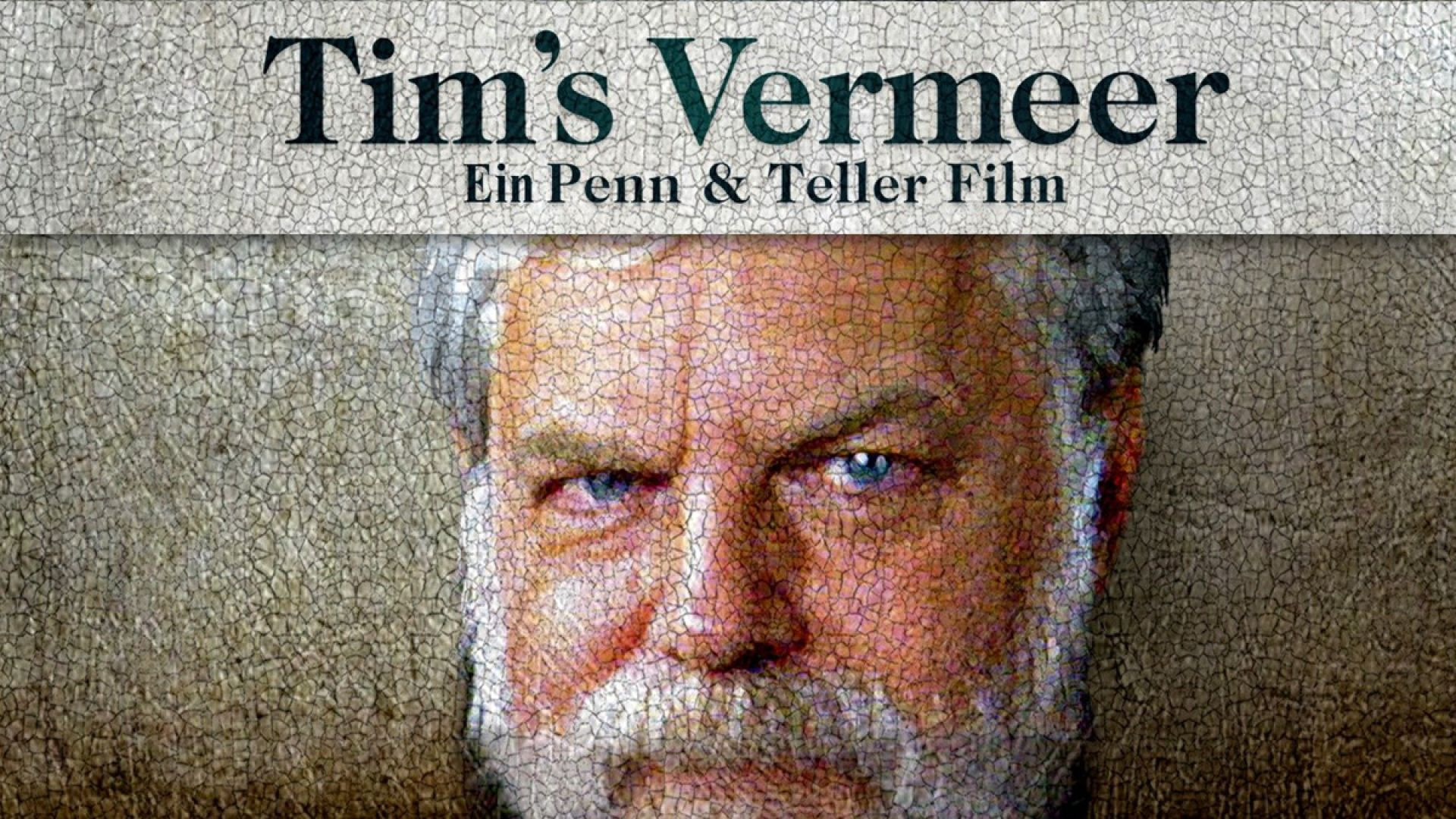
Tim's Vermeer is a 2013 documentary film, directed by Teller, produced by his stage partner Penn Jillette and Farley Ziegler, about inventor Tim Jenison's efforts to duplicate the painting techniques of Johannes Vermeer, in order to test his theory that Vermeer painted with the help of optical devices.
The film premiered at the 2013 Toronto International Film Festival and was released in limited theatrical release in the United States by Sony Pictures Classics on January 31, 2014 Tim Jenison is an inventor and successful founder of NewTek, a company working in various fields of computer graphics, most notably the 3D modeling software "LightWave 3D." Jenison, himself both an engineer and art enthusiast, becomes fascinated with the paintings of Johannes Vermeer, a 17th-century Dutch painter whose paintings have often been said to exhibit a photographic quality. Jenison, spurred by the 2001 book Secret Knowledge by British artist David Hockney and Vermeer's Camera by British architecture professor Philip Steadman, theorizes that Vermeer potentially used a camera obscura to guide his painting technique. His initial idea, that Vermeer used a simple light projection to paint, is quickly discarded after concluding that painting over a projection makes it nearly impossible to match the colors correctly. Jenison then has an epiphany of using a mirror to monitor parts of the picture: by placing a small, fixed mirror above the canvas at a 45-degree angle, he is able to view parts of the original image and the canvas simultaneously, and obtain a precise color match by continuously comparing the reflection of the original image with what he has put on the canvas, moving from area to area by simply moving his own point-of-view slightly. When the edge of the mirror "disappears", he has it right.

"SUPERHUMAN: The Invisible Made Visible" documents the jaw-dropping experiences of individuals with extra-sensory powers that seem to defy the laws of physics known to man today. Producer and host Caroline Cory, who has her own extensive experience in the field of Consciousness Studies and Extra Sensory Perception, takes the viewers on an extraordinary journey to achieve tangible and measurable proof of these seemingly miraculous phenomena.
Through a series of groundbreaking on-camera scientific experiments, viewers will find themselves connecting the dots about the true nature of their own consciousness, the relation between mind and matter and discover whether they live in a simulated matrix or if they can have control over their physical reality and create a fulfilling human experience. The film ultimately shows that once the invisible worlds are made visible, this attained higher awareness will transform humans into superhumans.

Based upon Theosophy (the Secret Doctrine) this documentary focuses on the evolution of consciousness over millions of years while revealing the secret chronology of human history from ancient Lemuria and Atlantis to our current root race, while following the natural cyclic deluges between races.

My Friend Rockefeller’Tells The Story Of The Infamous Imposter, Christian Karl Gerhartsreiter.
There's no shortage of shocking stories about feigned identities - from Anna Delvey to John Meehan, con men and women are ubiquitous. But few stories involve a move from Germany, five identities, and the Rockefeller family name. The fascinating story of Christian Gerhartsreiter manages to include all three. Gerhartsreiter made his way across the US, ingratiating himself into wealthy communities until he settled in New York City. There, Gerhartsreiter married a Harvard grad and pretended to work in prestigious philanthropic positions, all the while hobnobbing with some of the richest and most prominent members of American high society.
Gerhartsreiter's life imploded when his wife decided to seek a divorce. Gerhartsreiter took their daughter, of whom he had lost custody, and prepared to sail abroad under a different identity. Police discovered the plan before he could escape and soon detained him. Authorities uncovered Gerhartsreiter's trail of lies, one of which implicated him in the slaying of a man and a missing woman.
The documentary My Friend Rockefeller tells Christian Karl Gerhartsreiter's real story. My Friend Rockefeller reviews suggest the film successfully analyzes why Christian Karl Gerhartsreiter used the name Clark Rockefeller, and describes what has happened since he was apprehended in 2008. As of 2019, he's serving time, possibly for the rest of his life. His story has inspired a movie called Who Is Clark Rockefeller?, as well as several books and podcast episodes. Gerhartsreiter will live in infamy, though likely not for the reasons he hoped.
Gerhartsreiter Used Five Different Identities Over 30 Years
After Gerhartsreiter took his daughter, police discovered that his friends knew him as a number of different identities. Some knew him as Chris Gerhart, a film student at the University of Wisconsin. He had also gone by Christopher C. Crowe when he worked as a TV producer in the late '80s. Others knew him as an alleged British royal, Christopher Chichester, who suddenly left Los Angeles in the 1980s following a couple's disappearance.
By the time Gerhartsreiter fled Boston with his daughter, his friends and his wife Sandra Boss knew him as Clark Rockefeller. The alleged Rockefeller worked and lived among some of the country's most wealthy.
Gerhartsreiter Successfully Convinced An Entire Community That He Inherited A Part Of The Rockefeller Fortune
The alleged Rockefeller convinced not one, but two communities of lawyers, doctors, artists, and writers that he was a descendant of the Rockefeller family. In New York, he took his prestigious friends to country clubs and showed off his "art collection," which authorities later determined was fake.
In Boston, Gerhartsreiter ingratiated himself with a community of wealthy people who often met at a Starbucks near his daughter's school. Gerhartsreiter became the director of the Algonquin Club and invited his elite friends, even if he did charge them for their visits. John Greene, who was adjacent to Gerhartsreiter's circle, said he easily convinced them he was a Rockefeller, claiming, "At a club like that - very Yankee, old-boys, blue blood - people get [excited] over the name."
REVIEW RESOURCE: https://www.ranker.com/list/my....-friend-rockefeller-

The Creepy Line reveals the stunning degree to which society is manipulated by Google and Facebook and blows the lid off the remarkably subtle – hence powerful – manner in which they do it.
Offering first-hand accounts, scientific experiments and detailed analysis, the film examines what is at risk when these tech titans have free reign to utilise the public’s most private and personal data.

In the 1960s, Ric O’Barry captured and trained dolphins for the hit television show Flipper. Regretful of his actions, he has since reinvented himself as a dolphin activist, working tirelessly to shine a light on the dark practices of dolphin capture and slaughter.
The Cove centres around O’Barry’s quest to expose the ugly reality of dolphin drive hunting — the practice of herding dolphins into a contained area where they will be caught and sold to aquariums or brutally killed for their meat.
In the Japanese seaside village of Taiji, this highly-profitable industry is conducted under a veil of secrecy. O’Barry is convinced that if the public could see actual footage of the butchery, they would demand that it be stopped. The Cove is part nature documentary, part spy thriller as the activist filmmakers use state-of-the-art technology and old-fashioned trickery to uncover the horrific hidden truths behind Taiji’s cove walls.

The Big Picture of Child Trafficking - PizzaGate & Beyond: Part 1, Mind Control Culture: Part 2
This documentary by Renegade Films explores the dark agenda behind the sexualization of children for mass mind control. International Jewry is using mind control to facilitate their White Genocide agenda.
EVERY American MUST KNOW we were attacked by Israel on June 8, 1967 in the USS Liberty Attack where Israel KNOWINGLY killed 34 Americans and wounded 171 others, BIGGEST COVER-UP IN WORLD HISTORY, NOT TAUGHT IN YOUR FAKE HISTORY BOOKS!
Israel also did 9/11, JEWS did 9/11, NOT MUSLIMS/ARABS! Research "The 5 Dancing Israelis' on 9/11", make signs that say ISRAEL DID 9/11 and EXPEL THE JEWS and hit the streets with the message, NAME THE JEW!
EXPEL THE JEWS! Vote Patrick Little 2020, he will expel the Jews by 2022, his campaign slogan is: "Liberate the US from the Jewish Oligarchy!" He will serve America NOT Israel, NO MORE WARS FOR ISRAEL under Patrick Little! SPREAD THE WORD, TELL EVERYONE YOU KNOW AND TELL THEM TO DO THE SAME!
MAKE THE TRUTH GO VIRAL, the sleeping masses MUST AWAKEN!

“Project Nim,” a new documentary by James Marsh, is a probing, unsettling study of primate behavior, focusing on the complex dynamics of power, sex and group bonding in a species whose startling capacity for selfishness and aggression is offset by occasional displays of intelligence and compassion.
His name — a human imposition, like everything else in this creature’s remarkable, heartbreaking life — is Nim Chimpsky. In the 1970s he enjoyed (or endured) a season of fame as a research subject. Shortly after his birth at an primate behavior, Nim was taken from his mother’s side and delivered to New York, where he became part of an experiment, led by a Columbia professor, Herbert Terrace, to determine whether an ape could be taught human language.
It is a bit curious that Mr. Marsh’s film has nothing to say about the roots of Nim’s name, a jab at the influential linguist Noam Chomsky, whose theories about the innateness and uniqueness of language to humans were the implicit target of Dr. Terrace’s work. His project was an effort to discern if a chimpanzee could learn sign language and if that learning could proceed beyond the mimicry of specific gestures into the creation of grammatical sentences. If Nim could be raised more or less as a human child, and could master human communication, that would challenge the Chomskyan idea of language as a special, hard-wired trait fundamentally separating us from other animals. (Koko the gorilla, another celebrated signing ape born around the same time as Nim, also tested this hypothesis.)
“Project Nim” glances briefly at the scientific controversy that shaped Nim’s fate, but Mr. Marsh is less interested in comparatively dry matters of linguistics or neurobiology than in a humid, messy domain of identity and emotion that has, in the past, been the terrain of psychoanalysis. And of literature: Nim, thrown from one home to another, vulnerable to cruelty and neglect and dependent on the kindness of strangers, resembles the titular hero of a Dickens novel, an orphan buffeted by circumstances whose biography is also a fable of individual virtue and social injustice.
A helpless innocent compared with his protectors and tormentors, Nim bounces like a long-armed David Copperfield from one unnatural home to another — a Manhattan brownstone, an estate in the Bronx, a medical testing center upstate — living through periods of pastoral bliss and gothic horror. His tale is Dickensian, but also Kafkaesque, since he is at the mercy of powerful forces beyond his ken or control.
Red Peter, the learned ape in Kafka’s devastating “Report to an Academy,” dreams, above all else, of a “way out,” and to watch footage of the young Nim at play and in confinement is to infer that he must have known a similar longing. Unlike the Kafka character, however, this educated primate never acquired enough words to tell us his story, and so “Project Nim” relies on human interlocutors, some of whom cared about Nim a great deal, almost all of whom wind up telling us more about themselves.
They are a remarkable collection, often at odds and sometimes in bed with one another, with Nim as their pawn, rival or surrogate child as well as the blank slate on which they inscribe their fantasies and intellectual conceits. Dr. Terrace, speaking with precision and detachment in present-day interviews, is either resigned to being the film’s designated villain or oblivious to being set up for that role. His former colleagues, some of them also former lovers, don’t have much good to say, and the ’70s footage, showing an academic dandy with a comb-over, a BMW and a Burt Reynolds mustache, is hardly flattering.
For the first few years of Nim’s life, Dr. Terrace was the master of his fate, though not always a significant presence in the chimp’s day-to-day routine. After leaving Oklahoma, Nim was installed in the home of Stephanie LaFarge, where he became part of a household that included seven children, at least one dog and Ms. LaFarge’s husband, a poet and “rich hippie” who appears to have been Nim’s romantic rival.
Ms. LaFarge, an open and genial interview subject, drops a few casual bombshells testifying to what the psychobabble of our own time might call boundary issues. “It was the ’70s,” her now grown-up daughter Jenny Lee says, but even then, and even on the Upper West Side, it might have been a bit unusual for a woman to breastfeed a baby chimpanzee.
After a while, Nim was transferred to an estate in Riverdale, cared for and tutored by young people — most of them women — who come before Mr. Marsh’s camera in middle age to recall the pleasures and dangers of working with their spirited simian charge. It is hard not to be charmed by the affection that passes between these humans and the chimp, or to appreciate what seems to be a reciprocated effort at communication. But at the same time it is difficult to avoid a certain queasiness at the sight of a wild creature forcibly and irrevocably alienated from his nature — dressed in clothes, tethered and caged, smoking a joint out in the woods with his pals. You laugh, sometimes, to force the lump out of your throat.
There is no doubt that Nim was exploited, and also no doubt that he was loved. Mr. Marsh, by allowing those closest to Nim plenty of room to explain themselves, examines the moral complexity of this story without didacticism. He allows the viewer, alternately appalled, touched and fascinated, to be snagged on some of its ethical thorns. He also engages in a bit of manipulation, using sleight-of-hand re-enactments and Dickon Hinchliffe’s nerve-rackingly melodramatic score to sensationalize a drama that hardly requires it.
Mr. Marsh, whose last documentary was the lovely, Oscar-winning “Man on Wire,” is a patient listener and an able storyteller, but the subject of “Project Nim” is so rich and strange that it might have benefited from the hand of a wilder, bolder filmmaker. An obsessive like Errol Morris or Werner Herzog might have pushed beyond pathos and curiosity, deeper into the literal no man’s land that lies between us and our estranged animal relations. But it is also possible that our language and our science do not equip us to understand the truth about Nim — or the truth about us that he may have discovered through years of rigorous, involuntary research.
“Project Nim” is rated PG-13 (Parents strongly cautioned). Strong language, drug use, sexual references and depictions of animal suffering.
REVIEW RESOURCE: https://www.nytimes.com/2011/0....7/08/movies/project-

A true twentieth-century trailblazer, Harvey Milk was an outspoken human rights activist and one of the first openly gay U.S. politicians elected to public office; even after his assassination in 1978, he continues to inspire disenfranchised people around the world. The Oscar-winning The Times of Harvey Milk, directed by Robert Epstein and produced by Richard Schmiechen, was as groundbreaking as its subject.
One of the first feature documentaries to address gay life in America, it’s a work of advocacy itself, bringing Milk’s message of hope and equality to a wider audience. This exhilarating trove of original documentary material and archival footage is as much a vivid portrait of a time and place (San Francisco’s historic Castro District in the seventies) as a testament to the legacy of a political visionary.
This documentary examines the political life of the self-proclaimed "Mayor Of Castro Street," N.Y. stockbroker turned San Francisco activist Harvey Milk, the first openly gay politician elected to public office in California. Milk was elected to a City Supervisor position in the '70s, when a successful gay politician was an anomaly, but Milk made the most of his brief time in power. When Dan White killed Milk and Mayor George Moscone, the loss experienced by Milk's supporters was profound.
White robbed the gay-rights movement of a charismatic leader and eloquent voice, but he accidentally gave it something a smart political operative like Milk would surely have appreciated the power and value of: a bona fide martyr.

For more than 20 years the CIA studied psychic abilities for use in their top-secret spy program. With previously classified details about ESP now finally coming to light, there can be no more secrets.
Two physicists discover psychic abilities are real only to have their experiments at Stanford co-opted by the CIA and their research silenced by the demands of secrecy. Yet, as both these 'remote viewers' and our audience learn, the 'more you hide something, the more it shines like a beacon in psychic space and this ancient truth can no longer be suppressed.'
The true story of Russell Targ and America's cold war psychic spies, disclosed and declassified for the first time, with evidence presented by a Nobel Laureate, an Apollo Astronaut, and the military and scientific community that has been suppressed for nearly 30 years, now able to speak for the first time.
Targ's understated mantra that "the evidence for extra sensory perception is overwhelming and shows a talent we all share and deserve to know about, leaves us not just with a greater understanding of this unique chapter in U.S. history, but perhaps most importantly a greater understanding of who we are and our larger connection to the world. The CIA, NSA and DIA used it, your tax dollars paid for it, and now you deserve to know about it.
Zeitgeist: Moving Forward, by director Peter Joseph, is a feature length documentary work which will present a case for a needed transition out of the current socioeconomic monetary paradigm which governs the entire world society.
This subject matter will transcend the issues of cultural relativism and traditional ideology and move to relate the core, empirical “life ground” attributes of human and social survival, extrapolating those immutable natural laws into a new sustainable social paradigm called a “Resource-Based Economy”. This film will feature experts in the fields of public health, anthropology, neurobiology, economics, energy, technology, social science and other relevant subjects which relate to social operation and culture.
The three central themes of the work are Human Behavior, Monetary Economics, and Applied Science. Put together the work creates a model of understanding the current social paradigm; why it is critical to move out of it - coupled with a new, radical, yet practical social approach based on advanced understandings which would resolve the current social woes facing the world today.
One of the unique attributes of this work, which separates it in style from most documentaries, is that it has a parallel dramatic/cinematic theme, with notable actors, which abstractly play out various gestures related to the overall message of the film. The work also vigorously employs numerous 2d and 3d visual abstracts/animations, while returning to the standard, traditional documentary orientation as the foundation.

The second documentary film of the series, Zeitgeist: Addendum, attempts to locate the root causes of this pervasive social corruption, while offering a solution.
Building upon the topics of social distortion and corruption, Addendum moves to also present possible solutions. Featured in the work is former “Economic Hit-man” and New York Times bestselling author, John Perkins, along with The Venus Project, an organisation for social redesign created by Social Engineer and Industrial Designer Jacque Fresco.
The original Zeitgeist was actually not a “film”, but a performance piece, which consisted of a vaudevillian style multi-media event using recorded music, live instruments and video. The event was given over a 6-night period in New York City and then, without any interest to professionally release or produce the work, was “tossed” up on the Internet arbitrarily. The work was never designed as a film or even a documentary in a traditional sense - it was designed as a creative, provoking, emotionally driven expression, full of artistic extremity and heavily stylized gestures. However, once online, an unexpected flood of interest began to generate. Within 6 months over 50 Million views were recorded on Google Video counters. Suddenly “Zeitgeist” the event, became “Zeitgeist: The Movie”.
Zeitgeist: The Movie (2007) is a treatment on Mythology and Belief in society today, presenting uncommon perspectives of common cultural issues. Chapter 1, “The Greatest Story Ever Told”, presents historical data relating to the astronomical/astrological origins of the Judeo-Christian theology (which can be extended to Islam as well), along with the understanding that these respective stories, beliefs & traditions are really an adaptation-extension of prior Pagan beliefs.
Chapter 2, “All the World’s a Stage”, presents a controversial view of the events of Sept. 11th 2001. It describes how the event has been transformed into a sacred, near religious act and to challenge the orthodox view, regardless of the quality of the contrary arguments, is considered blasphemy and rejected.
Chapter 3, “Don’t Mind the Men Behind The Curtain “, presents a shotgun tour through the subjects of Central Banking, War Pretexts, Banking Panics, the Military Industrial Complex, Media Culture and ultimately the mental neurosis and deadly addiction known as “Power.” The central theme is how society is often misled when it comes to certain pivotal historical events, what those events serve in function, along with how the overall social conditioning patterns we see today function to create values and perspectives which support and perpetuate the static, established order/power structure, as opposed to fluid social change and productive evolution for the betterment of the society as a whole.
The director, producer, writer, cinematographer, composer, editor and narrator of the work, Peter Joseph, was inadvertently brought into recognition within the documentary film community with his award winning, controversial, 2007 work “Zeitgeist: The Movie” which obtained over 100,000,000 views online during the first year of its publication.
Since that time, he continues to focus on media related expressions, including music composition, performance & film production, each with the focus on affecting society for the better. He has also lectured around the world on the topics of social sustainability and filmmaking and has been featured in the New York Times, Russia Today, TedX, CineFuturo and many other outlets. His film series have earned dozen of awards and have been screened in virtually every country and in over 40 languages. For more about The Zeitgeist Film Series and its history: www.zeitgeistmovie.com

The original Zeitgeist was actually not a “film”, but a performance piece, which consisted of a vaudevillian style multi-media event using recorded music, live instruments and video. The event was given over a 6-night period in New York City and then, without any interest to professionally release or produce the work, was “tossed” up on the Internet arbitrarily. The work was never designed as a film or even a documentary in a traditional sense - it was designed as a creative, provoking, emotionally driven expression, full of artistic extremity and heavily stylized gestures. However, once online, an unexpected flood of interest began to generate. Within 6 months over 50 Million views were recorded on Google Video counters. Suddenly “Zeitgeist” the event, became “Zeitgeist: The Movie”.
Zeitgeist: The Movie (2007) is a treatment on Mythology and Belief in society today, presenting uncommon perspectives of common cultural issues.
Chapter 1, “The Greatest Story Ever Told”, presents historical data relating to the astronomical/astrological origins of the Judeo-Christian theology (which can be extended to Islam as well), along with the understanding that these respective stories, beliefs & traditions are really an adaptation-extension of prior Pagan beliefs.
Chapter 2, “All the World’s a Stage”, presents a controversial view of the events of Sept. 11th 2001. It describes how the event has been transformed into a sacred, near religious act and to challenge the orthodox view, regardless of the quality of the contrary arguments, is considered blasphemy and rejected.
Chapter 3, “Don’t Mind the Men Behind The Curtain “, presents a shotgun tour through the subjects of Central Banking, War Pretexts, Banking Panics, the Military Industrial Complex, Media Culture and ultimately the mental neurosis and deadly addiction known as “Power.” The central theme is how society is often misled when it comes to certain pivotal historical events, what those events serve in function, along with how the overall social conditioning patterns we see today function to create values and perspectives which support and perpetuate the static, established order/power structure, as opposed to fluid social change and productive evolution for the betterment of the society as a whole.

The History of the Devil is wickedly good, informative and concise. A no-frills Welsh film produced in association with SBS Australia and distributed by Siren Visual, it’s roughly 52 minutes in length and packs a fair dinkum amount of history into its slender running time.
The documentary itself is made up entirely of mostly still images alternating sporadically with talking heads; religious scholars, theologians and reverends.
Directed by Greg Moodie and written and produced by Dave Flitton, it was researched by Eibhleann Ni Ghriofa, Deirdre Learmont and Craig McGregor.
It’s an impressive and very open-minded account and offers some fantastic insight into the evolution; the hows and whys the specter of the Devil has existed and morphed through the ages from the dawn of civilization through to the new millennium.
So despite its relatively low-fi approach, the richness and diversity of its imagery; the historical plaques, plates, engravings, illustrations, paintings, drawings, and the occasional staged re-enactment (some dude dressed up in rather bemusing demonic attire), keeps the documentary at a high level of beguilement.

Seaspiracy is absolutely shocking. It’s a damning and illuminating documentary that lifts the shiny veil clinging to our oceans to expose a rotten and corrupt core. Behind the sustainable promises from big corporations and plastic straw campaigns worldwide, the real truth is left hidden. Under this plastic layer of deception though is an industry that’s literally killing our oceans.
This 90 minute documentary is an unflinching look at the damage done to our blue planet. Well-researched and hard-hitting, what begins as an examination into whaling soon spirals into so much worse. Pest control, deceptively coloured salmon and sea piracy are but a few topics discussed here, and the longer the film goes on the more horrifying the truths are.
A lot of the time buzz words like “must-see” and “shocking” are thrown around the entertainment industry and lose their credibility. Honestly though, this film deserves both those labels. Every part of this industry is mired in corruption and greed, right the way through to the non-profit organizations that serve as wolves in sheep’s clothing.
What’s particularly interesting here though is just how much the buck is passed around. No one seems able to answer simple questions and as the film progresses, this becomes more and more apparent.
This globe-trotting documentary examines all forms of ocean corruption, from salmon farms in Scotland across to Shark Fin markets in China. A lot of these scenes are shot with either shaky handheld or spy cameras, backing up the threat these filmmakers face in doing this. In fact, one scene shows the camera crew forced to scramble out a building mid-interview thanks to a police tip off.
Alongside this fly-on-the-wall approach are a lot of facts that use great comparisons to show the devastation of the damage done to our oceans. Understanding the sheer scale of this through diagrams or expository text laid over establishing shots works really well to hammer home the message.
Sure, some people will go into this and write it off as sensationalist or conspiratorial but to be honest, the fact Ali Tabrizi and his team had so many issues interviewing higher-ups to explain themselves is pretty telling.
The final 15 minutes of this documentary changes tone slightly, with a poignant, sombre reminder of what’s happening to our oceans. With the water bleached a sickly shade of red, these scenes depict a form of whaling called Grind. The sound design here in particular is harrowing, and coupled with the images themselves, make for an incredibly difficult watch.
REVIEW RESOURCE: https://www.thereviewgeek.com/....seaspiracy-movierevi
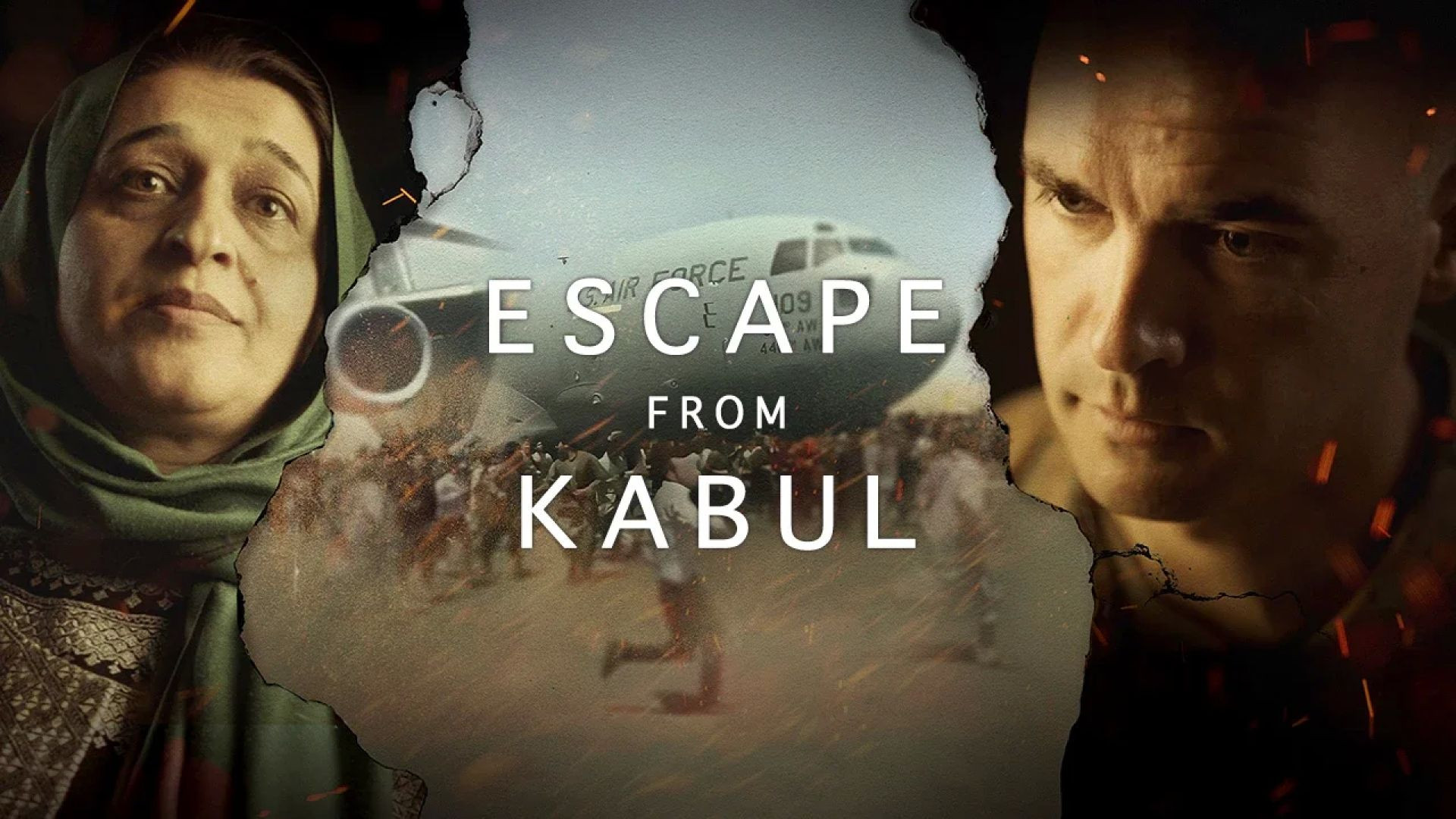
This documentary from Jamie Roberts on the evacuation of the airport at Kabul in August 2021 feels more like a lengthy news segment.
Airing on HBO a little more than a year after the American withdrawal from Afghanistan, “Escape From Kabul” presents a detailed account of the chaotic evacuation at the Kabul airport in August 2021. Directed by Jamie Roberts, whose “Four Hours at the Capitol” premiered just nine months after the Capitol riot, “Escape From Kabul” in some ways feels more like a lengthy news segment than a feature documentary.
The stories — and types of footage — will be familiar to anyone who sat glued to the television that August. We hear from Marines who were at the airport; from Afghans who got out and who didn’t; and from Taliban members who moved on Kabul. At least one acts surprised that women and children might be terrified of their arrival.
There is talk of the crushing size of the crowds and the squalid conditions at the airport. Lt. Col. Christopher R. Richardella describes logistical difficulties at various stages. Staff Sgt. Maria G. Solis explains how eerily normal it became for American troops to be passed babies by women trying to escape. Afghans like Hasina Safi, then the country’s acting minister for women’s affairs, and Malalai Hussainy, a first-year university student at the time, discuss their fears of brutality and a lack of education for women under Taliban leadership.
The movie lays out a clear timeline and is good at conveying the conflicted feelings that Afghans had about leaving their homes and that American troops had as they tried to maintain control of the situation. Still, “Escape From Kabul” is a short-term recap. A more robust movie, following these witnesses over several years, is still waiting to be made.
REVIEW RESOURCE: https://www.nytimes.com/2022/0....9/21/movies/escape-f

FILM ASKS HARD QUESTIONS ABOUT FAILURE OF ENVIRONMENTAL MOVEMENT TO HALT CLIMATE CHANGE AND SAVE PLANET
Directed by Jeff Gibbs and Executive Produced by Moore, film examines if we’ve been on “wrong road” with so-called “green energy” that is anything but green.
Charges environmental leaders have “lost their way” and “sold out to corporate interests.”
“As we suffer through one health and environmental crisis after another, it is clear we can no longer simply solar-panel-and-windmill our way out of this emergency,” say Moore and Gibbs.
Released on the eve of the 50th anniversary of Earth Day and in the midst of the global Covid-19 pandemic, Planet of the Humans takes a harsh look at how the environmental movement has lost the battle through well-meaning but disastrous choices, including the belief that solar panels and windmills would save us, and by giving in to the corporate interests of Wall Street.
The film is the debut movie from Jeff Gibbs, whom Moore calls “a brave and brilliant filmmaker whose new voice must be heard.” Gibbs is a lifelong environmentalist and longtime collaborator of Moore’s with whom he co-produced Bowling for Columbine and Fahrenheit 9/11. Planet of the Humans first screened as a work in progress at the most recent Traverse City Film Festival where it was a huge audience favorite.
Moore and Gibbs decided that with the American public – and much of the world – confined to their homes and suddenly having to consider the role humans and their behavior have played in our fragile ecosystems, the moment was too urgent to wait until later this year for the film’s planned release.
“We have ignored the warnings, and instead all sorts of so-called leaders have steered us away from the real solutions that might save us,” says Moore, who holds the all-time box office record for documentaries. “This movie takes no prisoners and exposes the truth about how we have been led astray in the fight to save the planet, to the point where if we don’t reverse course right now, events like the current pandemic will become numerous, devastating and insurmountable. The feel-good experience of this movie is that we actually have the smarts and the will to not let this happen – but only if we immediately launch a new environmental uprising.”
Jeff Gibbs, the writer/editor/director of Planet of the Humans, has dared to say what no one will – that “we are losing the battle to stop climate change because we are following environmental leaders, many of whom are well-intentioned, but who’ve sold out the green movement to wealthy interests and corporate America.
”This film is the wake-up call to the reality which we are afraid to face: that in the midst of a human-caused extinction event, the so-called “environmental movement’s” answer is to push for techno-fixes and band-aids. “It’s too little, too late,” says Gibbs. “Removed from the debate is the only thing that might save us: getting a grip on our out-of-control human presence and consumption. Why is this not the issue? Because that would be bad for profits, bad for business.”
“Have we environmentalists fallen for illusions, ‘green’ illusions, that are anything but green, because we’re scared that this is the end — and we’ve pinned all our hopes on things like solar panels and wind turbines? No amount of batteries are going to save us, and that is the urgent warning of this film.”
This compelling, must-see movie – a full-frontal assault on our sacred cows – is guaranteed to generate anger, debate, and, hopefully, a willingness to see our survival in a new way—before it’s too late.
RESOURCE: https://planetofthehumans.com
Let me know your thoughts in the comments
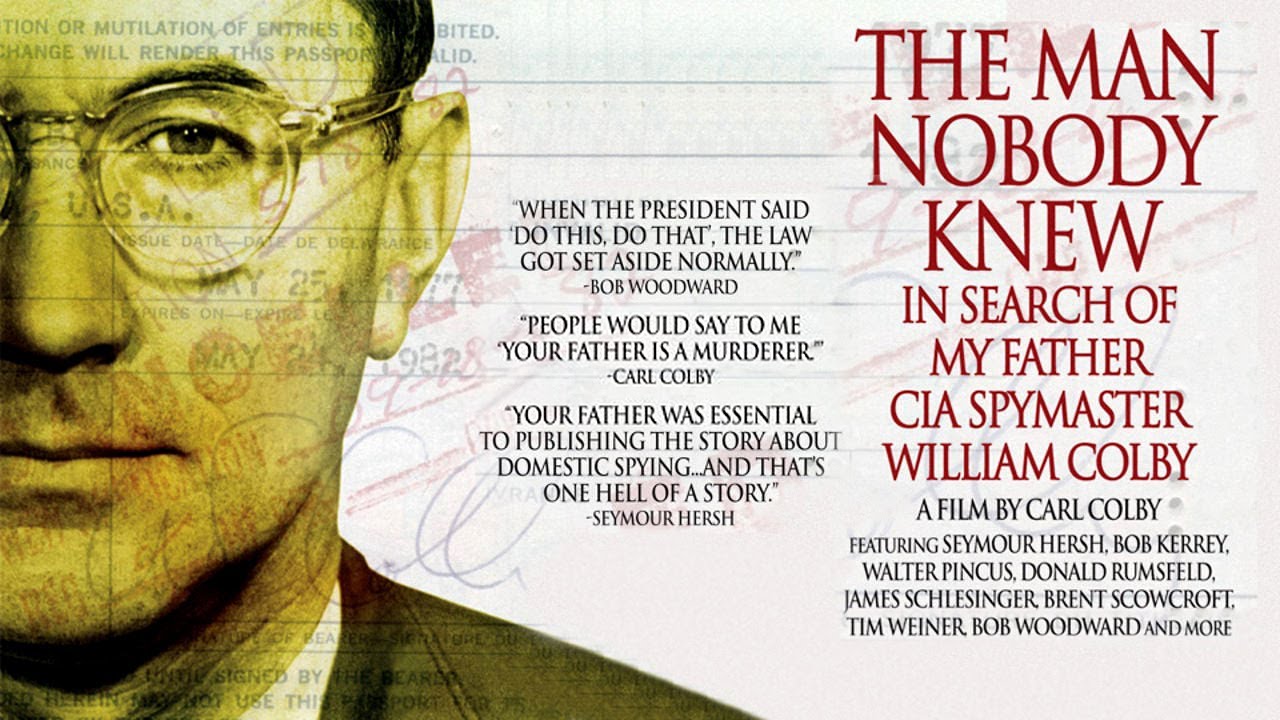
Carl Colby’s smart, fact-packed film “The Man Nobody Knew” operates on many levels, all riveting. Primarily an account of the career of his father, William Colby, director of the Central Intelligence Agency from 1973 to 1976, it traces a history ending in 1996, when his body washed ashore eight days after he embarked on a late-afternoon solo canoe outing in Maryland.
While reviewing the turbulent period spanning Vietnam and President Richard M. Nixon’s resignation, we also witness the arc of a marriage, the death of a daughter and the seeming disillusionment of a selfless, if steely-eyed and implacable, civil servant.William Colby was molded by the Office of Strategic Services in World War II, when he aided anti-Nazi insurgents in France and Norway. Working closely with the Vatican he fought the postwar Communist ascendance in Italy and helped coordinate the coup against President Ngo Dinh Diem of South Vietnam. As C.I.A. director he embraced covert activities until “the family jewels“ — memos revealing the agency’s domestic wiretapping and foreign assassination attempts, among other sordid pursuits — were leaked.
After disclosing details on such programs (several preceding his tenure) in Congressional hearings, he was replaced by George H. W. Bush.The Beltway insiders interviewed include the former national security adviser Brent Scowcroft, the journalist Seymour Hersh and, at his most smugly cynical, former Defense Secretary Donald H. Rumsfeld. Carl Colby’s mother, Barbara, meanwhile, is the embodiment of diplomatic poise and eloquence. Conspiracy theorists can have a field day with William Colby’s death, but “The Man Nobody Knew” suggests that the culprit may have been no more than a cold warrior’s crumbling facade.Directed by Carl Colby; edited by Jay Freund; music by Michael Bacon; produced by Mr. Colby, David Johnson and Grace Guggenheim; released by First Run Features. At the Lincoln Plaza, Broadway at 62nd Street. Running time: 1 hour 44 minutes. This film is not rated.
REVIEW RESOURCE: https://www.nytimes.com/2011/0....9/23/movies/man-nobo out the documentary channel: https://rumble.com/DocumentaryArchiveLet me know your thoughts in the comments.
