Documentary
زیر رده

The Light Bulb Conspiracy uncovers how planned obsolescence has shaped our lives and economy since the 1920’s, when manufacturers deliberately started shortening the life of consumer products to increase demand. The film also profiles a new generation of consumers, designers and business people who have started challenging planned obsolescence as an unsustainable economic driver.
The documentary begins by visiting the longest running light bulb in the world, which has burned continuously for over 110 years in Livermore, California. Initially, light bulbs were built to last. But the film finds historical evidence revealing how a cartel in the 1920’s decided to produce bulbs limited to a maximum life of 1000 hours, making the humble light bulb one of the first examples of planned obsolescence and a model for increasing profits on other products.
Shot over three years in Europe, the U.S. and Ghana, The Light Bulb Conspiracy investigates the evolution and impact of planned obsolescence through interviews with historians, economists, designers and manufacturers, along with archival footage and internal company documents. The film profiles several well-known historical advocates -- Bernard London, who famously proposed ending the Great Depression by mandating planned obsolescence, and Brook Stevens, whose post-war ideas became the gospel of the 1950’s and helped shape the throwaway consumer society of today.
The Light Bulb Conspiracy also looks at modern examples of planned obsolescence, including computer printers and the controversy over the inability to replace iPod batteries. Environmental consequences are seen most dramatically in the massive amounts of electronic waste that end up in uncontrolled dump sites in Third World countries such as Ghana. The film concludes with examples of consumers and businesses moving towards more sustainable practices and products, including Warner Philips, great grandson of the founder of Philips Electronics, who is producing an LED bulb designed to last 25 years.
REVIEW RESOURCE: https://www.videoproject.org/L....ight-Bulb-Conspiracy

The first authorized documentary film exploring David Icke's work and life. He is the famed conspiracy theorist, known as the “mad man” who has been proved right time and time again.
David Icke has been warning the public for almost three decades about the coming global Orwellian state in which a tiny few would enslave humanity through New World Order tactics. Methods such as control of finance, government, media, and a military-police Gestapo overseeing 24/7 surveillance of a microchipped population. He has said that “physical reality is an illusion" and that the "world" really is a holographic simulation created by a non-human force to lockdown human perception in ongoing servitude.
He has been subjected to decades of ridicule and dismissal over his theories. However, now his books are read all over the globe and his speaking events are watched by thousands. Why? Because what he foretold is playing out in world events and even some mainstream scientists are concluding that reality is indeed a simulation or "Matrix."
REVIEW RESOURCE: https://www.gaia.com/video/ren....egade-life-story-dav
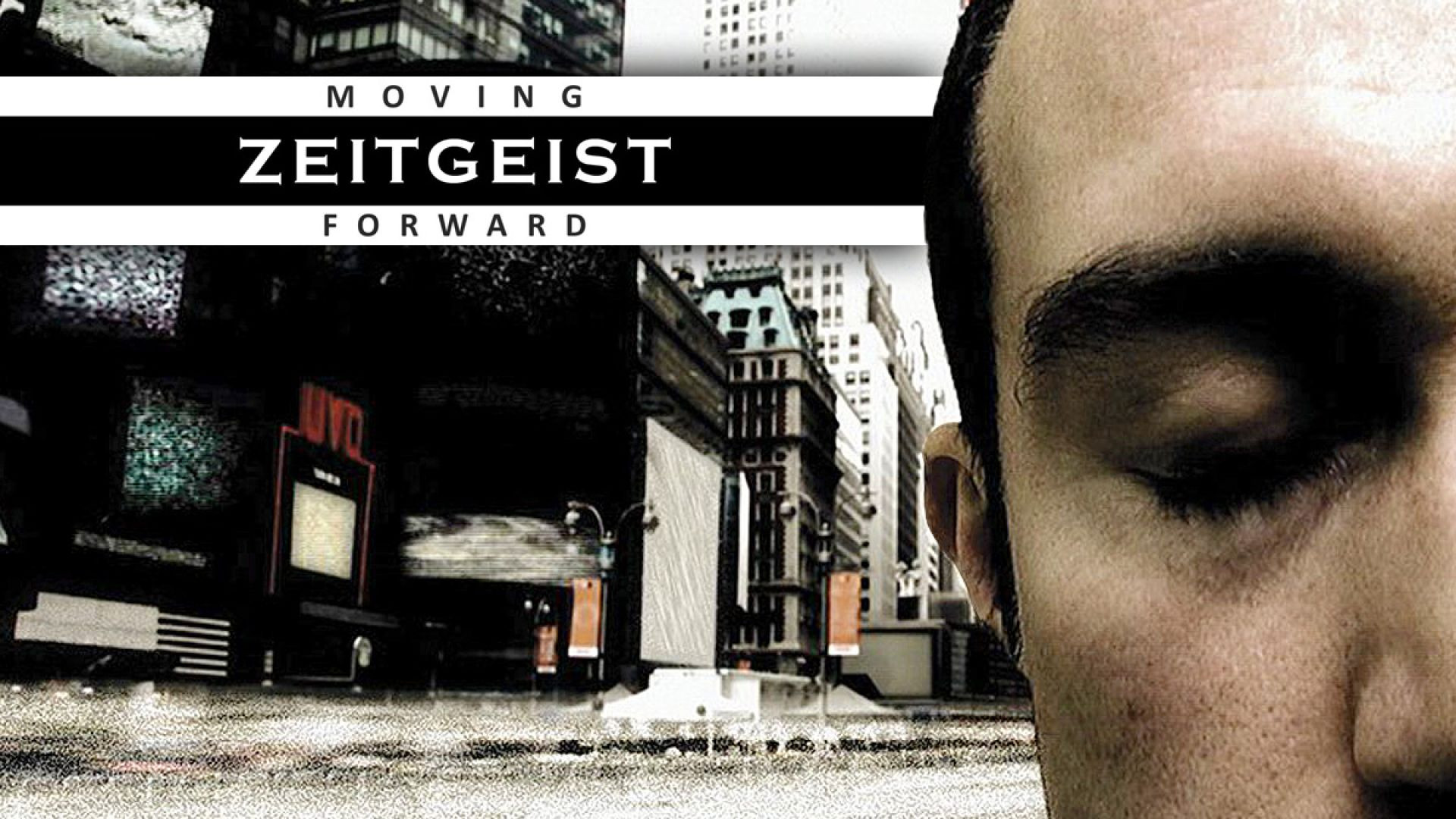
Zeitgeist: Moving Forward, by director Peter Joseph, is a feature length documentary work which will present a case for a needed transition out of the current socioeconomic monetary paradigm which governs the entire world society.
This subject matter will transcend the issues of cultural relativism and traditional ideology and move to relate the core, empirical “life ground” attributes of human and social survival, extrapolating those immutable natural laws into a new sustainable social paradigm called a “Resource-Based Economy”. This film will feature experts in the fields of public health, anthropology, neurobiology, economics, energy, technology, social science and other relevant subjects which relate to social operation and culture.
The three central themes of the work are Human Behavior, Monetary Economics, and Applied Science. Put together the work creates a model of understanding the current social paradigm; why it is critical to move out of it - coupled with a new, radical, yet practical social approach based on advanced understandings which would resolve the current social woes facing the world today.
One of the unique attributes of this work, which separates it in style from most documentaries, is that it has a parallel dramatic/cinematic theme, with notable actors, which abstractly play out various gestures related to the overall message of the film. The work also vigorously employs numerous 2d and 3d visual abstracts/animations, while returning to the standard, traditional documentary orientation as the foundation.
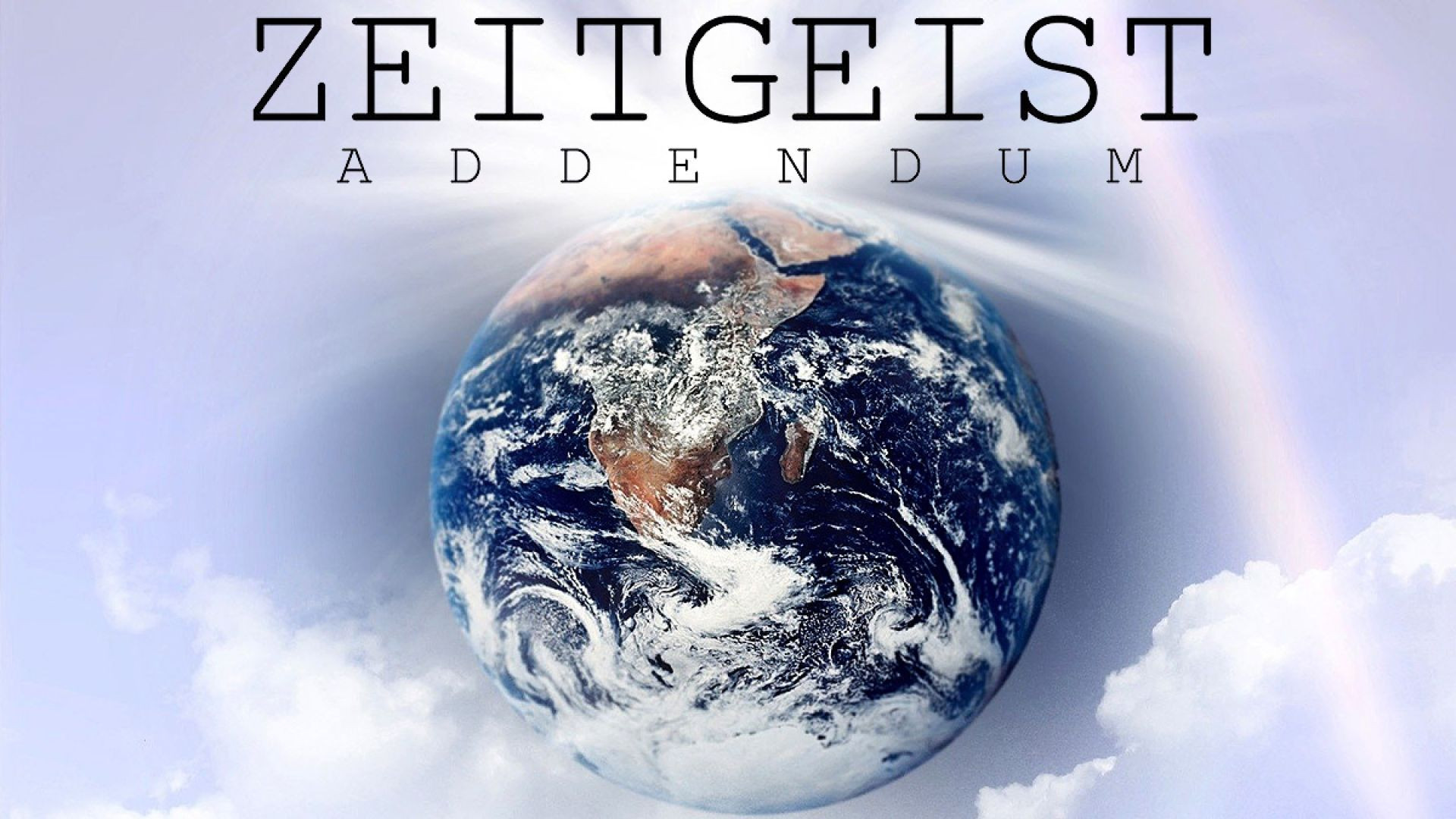
The second documentary film of the series, Zeitgeist: Addendum, attempts to locate the root causes of this pervasive social corruption, while offering a solution.
Building upon the topics of social distortion and corruption, Addendum moves to also present possible solutions. Featured in the work is former “Economic Hit-man” and New York Times bestselling author, John Perkins, along with The Venus Project, an organisation for social redesign created by Social Engineer and Industrial Designer Jacque Fresco.
The original Zeitgeist was actually not a “film”, but a performance piece, which consisted of a vaudevillian style multi-media event using recorded music, live instruments and video. The event was given over a 6-night period in New York City and then, without any interest to professionally release or produce the work, was “tossed” up on the Internet arbitrarily. The work was never designed as a film or even a documentary in a traditional sense - it was designed as a creative, provoking, emotionally driven expression, full of artistic extremity and heavily stylized gestures. However, once online, an unexpected flood of interest began to generate. Within 6 months over 50 Million views were recorded on Google Video counters. Suddenly “Zeitgeist” the event, became “Zeitgeist: The Movie”.
Zeitgeist: The Movie (2007) is a treatment on Mythology and Belief in society today, presenting uncommon perspectives of common cultural issues. Chapter 1, “The Greatest Story Ever Told”, presents historical data relating to the astronomical/astrological origins of the Judeo-Christian theology (which can be extended to Islam as well), along with the understanding that these respective stories, beliefs & traditions are really an adaptation-extension of prior Pagan beliefs.
Chapter 2, “All the World’s a Stage”, presents a controversial view of the events of Sept. 11th 2001. It describes how the event has been transformed into a sacred, near religious act and to challenge the orthodox view, regardless of the quality of the contrary arguments, is considered blasphemy and rejected.
Chapter 3, “Don’t Mind the Men Behind The Curtain “, presents a shotgun tour through the subjects of Central Banking, War Pretexts, Banking Panics, the Military Industrial Complex, Media Culture and ultimately the mental neurosis and deadly addiction known as “Power.” The central theme is how society is often misled when it comes to certain pivotal historical events, what those events serve in function, along with how the overall social conditioning patterns we see today function to create values and perspectives which support and perpetuate the static, established order/power structure, as opposed to fluid social change and productive evolution for the betterment of the society as a whole.
The director, producer, writer, cinematographer, composer, editor and narrator of the work, Peter Joseph, was inadvertently brought into recognition within the documentary film community with his award winning, controversial, 2007 work “Zeitgeist: The Movie” which obtained over 100,000,000 views online during the first year of its publication.
Since that time, he continues to focus on media related expressions, including music composition, performance & film production, each with the focus on affecting society for the better. He has also lectured around the world on the topics of social sustainability and filmmaking and has been featured in the New York Times, Russia Today, TedX, CineFuturo and many other outlets. His film series have earned dozen of awards and have been screened in virtually every country and in over 40 languages. For more about The Zeitgeist Film Series and its history: www.zeitgeistmovie.com

The original Zeitgeist was actually not a “film”, but a performance piece, which consisted of a vaudevillian style multi-media event using recorded music, live instruments and video. The event was given over a 6-night period in New York City and then, without any interest to professionally release or produce the work, was “tossed” up on the Internet arbitrarily. The work was never designed as a film or even a documentary in a traditional sense - it was designed as a creative, provoking, emotionally driven expression, full of artistic extremity and heavily stylized gestures. However, once online, an unexpected flood of interest began to generate. Within 6 months over 50 Million views were recorded on Google Video counters. Suddenly “Zeitgeist” the event, became “Zeitgeist: The Movie”.
Zeitgeist: The Movie (2007) is a treatment on Mythology and Belief in society today, presenting uncommon perspectives of common cultural issues.
Chapter 1, “The Greatest Story Ever Told”, presents historical data relating to the astronomical/astrological origins of the Judeo-Christian theology (which can be extended to Islam as well), along with the understanding that these respective stories, beliefs & traditions are really an adaptation-extension of prior Pagan beliefs.
Chapter 2, “All the World’s a Stage”, presents a controversial view of the events of Sept. 11th 2001. It describes how the event has been transformed into a sacred, near religious act and to challenge the orthodox view, regardless of the quality of the contrary arguments, is considered blasphemy and rejected.
Chapter 3, “Don’t Mind the Men Behind The Curtain “, presents a shotgun tour through the subjects of Central Banking, War Pretexts, Banking Panics, the Military Industrial Complex, Media Culture and ultimately the mental neurosis and deadly addiction known as “Power.” The central theme is how society is often misled when it comes to certain pivotal historical events, what those events serve in function, along with how the overall social conditioning patterns we see today function to create values and perspectives which support and perpetuate the static, established order/power structure, as opposed to fluid social change and productive evolution for the betterment of the society as a whole.

The History of the Devil is wickedly good, informative and concise. A no-frills Welsh film produced in association with SBS Australia and distributed by Siren Visual, it’s roughly 52 minutes in length and packs a fair dinkum amount of history into its slender running time.
The documentary itself is made up entirely of mostly still images alternating sporadically with talking heads; religious scholars, theologians and reverends.
Directed by Greg Moodie and written and produced by Dave Flitton, it was researched by Eibhleann Ni Ghriofa, Deirdre Learmont and Craig McGregor.
It’s an impressive and very open-minded account and offers some fantastic insight into the evolution; the hows and whys the specter of the Devil has existed and morphed through the ages from the dawn of civilization through to the new millennium.
So despite its relatively low-fi approach, the richness and diversity of its imagery; the historical plaques, plates, engravings, illustrations, paintings, drawings, and the occasional staged re-enactment (some dude dressed up in rather bemusing demonic attire), keeps the documentary at a high level of beguilement.
